
.
At what point along the way did we lose reason, the capacity for self-criticism, morality, and even our own memory?
This is not a rhetorical question. It is a diagnosis.
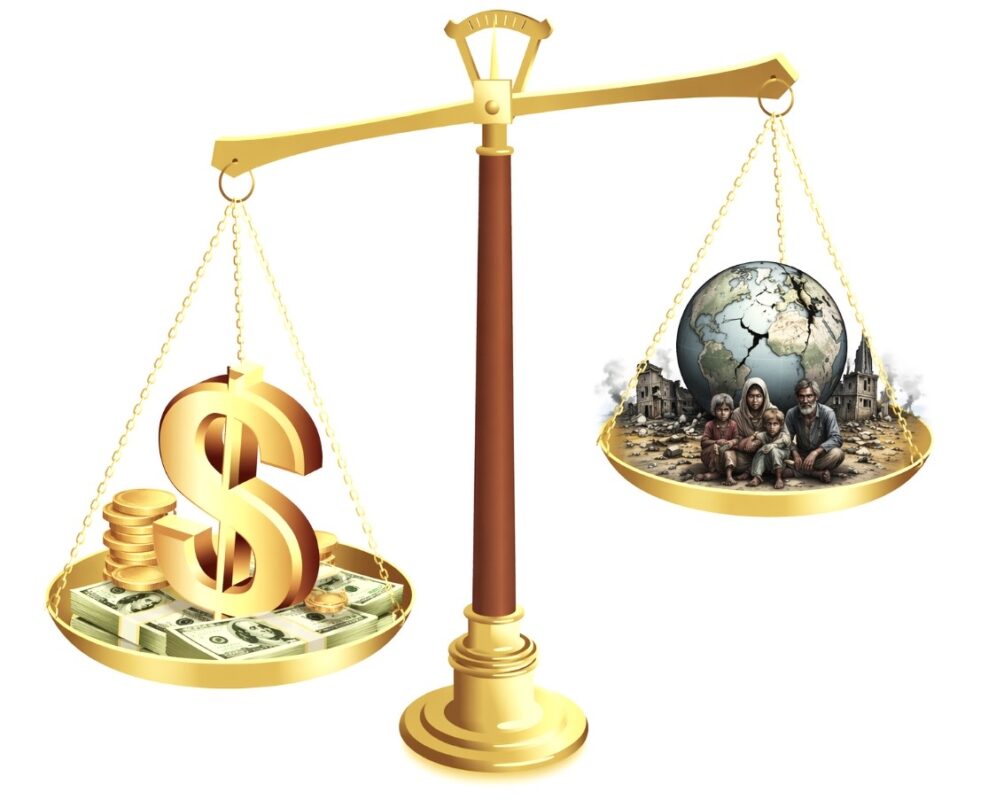
While one-third of humanity is still plagued by hunger across all five continents, the physical wealth accumulated by religious institutions exceeds trillions of dollars and euros. This is not about faith — it is about contradiction.
While divine love is preached, thousands of defenseless human beings are killed in the name of God. And what is most disturbing is not only the violence itself, but the fact that much of humanity, directly or indirectly, accepts, justifies, or remains silent in the face of it. Many are capable of killing to impose their faith — yet incapable of living the love they proclaim.
This is not new. It never was.
Since the earliest civilizations, we have sacrificed, crucified, idolized — always in the name of something greater. Today, we have merely refined the tools. Destruction remains as brutal as ever, only more efficient — and still, always unjustifiable.
Some provoke, threaten, impose. Others respond in kind, claiming self-defense. And so we remain trapped in a cycle where reason yields to instinct, and the capacity for discernment dissolves.
We inhabit an extraordinary, rare, almost miraculous universe. And yet, we are the only species capable of consciously destroying it.
In light of this, what can be said about silence?
A silence many attribute to the divine — inert, deaf to cries, blind to suffering. Or perhaps it is not the divine that fails, but the human systems that presume to speak in its name.
Systems that proclaim justice, yet operate corrupted by interests, power, and empty rhetoric.
Systems that wear robes or sacred garments not as symbols of truth, but as disguises of carefully embroidered hypocrisy.
And, in many cases, they display religious or ideological symbols as badges of virtue — emblems of a fragile freedom that has quietly normalized domination. They mark minds, identities, and destinies with submission, differing little — in essence — from the branding of animals as property. The difference is merely aesthetic; the mechanism of control remains.
In the name of faith, they accumulate wealth.
In the name of salvation, they sell promises.
In the name of morality, they impose fear.
They promise paradises no one can verify, while neglecting the tangible suffering before them. They speak of compassion, yet practice indifference.
And most critically: they institutionalize it.
They call “theological science” the set of mechanisms that sustain this machinery — a structure that does not liberate, but imprisons; does not enlighten, but conditions; does not elevate, but exploits.
Thus, entire generations are taught not to question, but to accept. Not to understand, but to fear.
And so the question returns — more urgent than ever:
Why do we insist on abandoning the most basic values of civilization?
Where did our reason atrophy?
At what point did we abandon it — and why?
Perhaps the answer is too uncomfortable to admit.
Perhaps we did not lose it all at once, but gradually — trading conscience for convenience, truth for comfort, responsibility for delegation.
And perhaps the greatest problem is not the absence of reason…
“but the silent — and morally inhumane — choice not to use it.”
The purpose of this reflection is not to condemn perceptions — whether healthy or distorted, fair or unjust, lucid or dulled by the absence of knowledge imposed upon minds conditioned to see according to interests that, in practice, oppose true evolution, sustained by a deplorable convenience.
Its purpose is different: to cast some light upon the dense twilight that surrounds us — and that quietly hinders the full exercise of discernment.
For in the end, the darkness around us will never be as dangerous as the one we choose not to illuminate.
If possible at all, how can we individually free ourselves from complicity in this reality — from systems that have, often unconsciously, co-opted us?
We often believe we are useful.
That we are part of something greater.
That we fulfill a necessary role.
But we rarely ask:
useful to what… and to whom?
If the machinery is sustained by unconscious repetition, perhaps the first act of rupture lies not in collective revolt, but in individual lucidity.
Refuse automatism.
Question what appears obvious.
Reexamine inherited beliefs.
Do not delegate to structures what belongs to conscience.
Perhaps it is not possible to fully break away from systems — but it is possible not to surrender to them blindly.
For true complicity lies not only in action…
but in the deliberate absence of reflection.
And at that point, freedom ceases to be an idea…
and becomes a choice.
Fanaticism is not faith — it is the collapse of reason.
It is the last refuge of those who need to impose what they cannot sustain.
They speak of faith like true ultracrepidarians — asserting authority over what they do not understand — and place themselves in the absurd role of “defenders” of divinities that, supposedly, would be omnipotent.
If a God needs to be defended by confused minds incapable of distinguishing reality from abstraction, then it is not God — it is projection.
The fanatic does not argue — he accuses.
He does not listen — he interrupts.
He does not think — he reacts.
He fiercely defends what was never under threat — because, in truth, what he protects is not the divine, but his own intellectual fragility.
There is something almost grotesque in the scene: limited beings, lost in basic contradictions, claiming to be spokesmen of the absolute.
And thus the cycle completes itself —
the smaller the capacity to reflect, the greater the need to impose.
Fanaticism does not elevate — it exposes.
Not the strength of faith, but the limits of the mind that sustains it.
_______
Commentary — Martin Donelll, Professor of Philosophy
The text presented goes beyond mere criticism — it stands as a call to intellectual and moral responsibility.
Its reach does not lie in the volume of its accusations, but in the way it exposes a structural inconsistency: the gap between the values humanity proclaims and those it actually upholds in practice.
This is not a text meant to please or persuade the masses.
It is a text aimed at awakening individual consciousness, capable of resisting automatic submission.
And throughout history, this has always been more dangerous — and more transformative — than any discourse of power.
________