

Sister Ruth DePaiva passed away in Keene, Texas (USA), on March 19, 2023. Pastor Itamar Sabino DePaiva followed her on January 11, 2025, at the age of 91.
.
Where Memory, Care, and Conscience Endure Beyond Time. Between time-yellowed lines, a letter from 1965 preserves the quiet integrity of a selfless couple who served without noise.
.
Olney, Maryland — Among personal documents preserved for decades, a letter dated April 11, 1965, recently found within family archives, offers a rare portrait of everyday life, human relationships, and the values that shaped Brazil at the time — especially in the Amazon region.
Written in Manaus by Pastor Itamar Sabino DePaiva, then associated with the Central Amazon Mission of the Seventh-day Adventist Church, the correspondence was sent to Captain Jairo Saraiva, a resident of Porto Velho — then the Federal Territory of Rondônia — where Pastor Itamar served as the city’s first Seventh-day Adventist pastor.
More than a formal exchange, the letter reveals care, responsibility, and affection dedicated to a child temporarily entrusted to the pastoral couple, in a context marked by vast geographic distances and scarce means of communication.
When Sister Ruth, Pastor Itamar’s wife, is mentioned, memory acquires an even more human and sensory dimension. One recalls the taste of the granola she prepared at dawn — made with oats, honey, and Brazil nuts — served with simplicity and kindness. Small gestures that, by surviving in memory, reveal the silent depth of everyday care.
Preserved for years by its recipient, the letter now transcends the private sphere. It stands as a historical document of social value, revealing practices of trust, accountability, attentiveness to childhood, and a form of religiosity lived simply, ethically, and daily — qualities increasingly rare in the contemporary world.
Although the author’s present reflections are guided more by reason than by faith, this record arises from a serene recognition of authentic human gestures. It is a testimony of gratitude not bound to labels or beliefs, but to the merit of people who lived with coherence, simplicity, and fidelity to the values they professed.
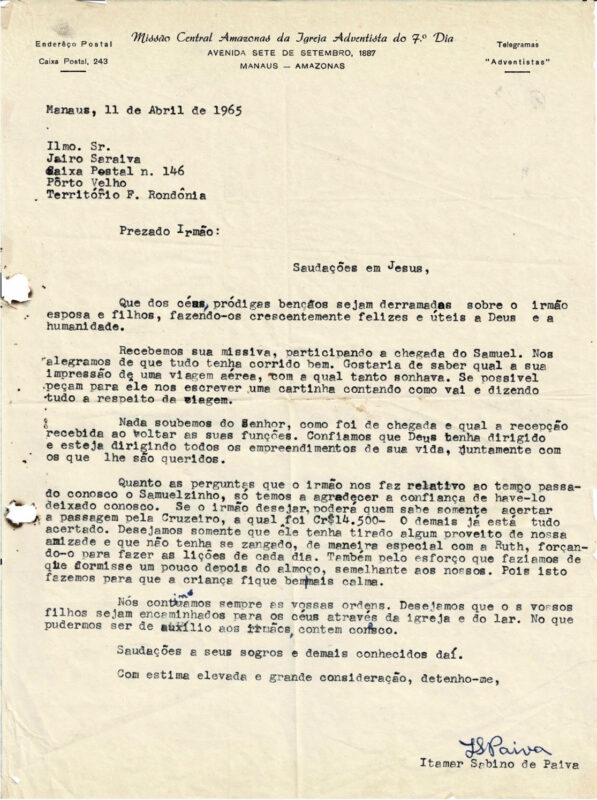
A Memoir-Style Reading of the Letter
(Manaus, April 11, 1965)
This letter, sent by the Central Amazon Mission of the Seventh-day Adventist Church, is far more than an administrative or religious communication. It is an intimate record of a journey — geographic, familial, and symbolic — through the heart of the Brazilian Amazon in the 1960s.
1. Time and Place
In 1965, Manaus still lived in the aftermath of the rubber boom and the logistical isolation of the deep Amazon. Porto Velho, then the Federal Territory of Rondônia, was even more remote. An airplane trip, mentioned with delight and curiosity, was no ordinary matter — it was an extraordinary event, almost epic, especially for a child.
The letter reveals this gently:
“I would like to know what your impression was of an airplane trip, which you had dreamed of for so long.”
There is no bureaucratic tone here — only genuine wonder.
2. “Samuelzinho”: The Child as Moral Center
Samuel is not treated as a “minor,” a “dependent,” or merely an accompanying child. He is the emotional and ethical center of the narrative. The diminutive “Samuelzinho” does not infantilize — it humanizes.
The authors feel an almost pastoral responsibility to justify every aspect of care:
- school discipline,
- rest after lunch,
- conflict mediation (especially involving Ruth).
“We did this so that the child would remain calmer.”
This sentence reveals something rare: conscious emotional responsibility. It was not mere hospitality — it was a temporary moral guardianship.
3. Trust Between Adults
One word silently permeates the entire letter: trust.
“We are grateful for the trust you placed in us by leaving him in our care.”
In a Brazil without cell phones, tracking, or instant communication, entrusting a child to others was an act of real faith, not rhetorical faith. The letter returns that trust with transparency, including financial clarity.
4. The Fare: Cr$ 14,500
The explicit mention of the airfare paid to Cruzeiro do Sul Airlines is no trivial detail. On the contrary, it:
- demonstrates accountability,
- avoids any shadow of doubt,
- reveals an almost handcrafted ethic of honor.
There is no demand, only clarification:
“Everything else has already been settled.”
This speaks volumes about the time — and perhaps even more about the people.
5. Religion Without Fanaticism
Although deeply Christian, the letter is not dogmatic. Faith appears as a language of care, not of imposition.
“We wish that your children may be guided toward heaven through both church and home.”
Church and home are placed on the same level. There is no hierarchy — only continuity.
6. The Signature
Pastor Itamar Sabino DePaiva’s signature closes the letter with a formula now almost vanished:
“With high esteem and great consideration, I remain,”
It marks the end not merely of a text, but of a gesture — a way of saying: I have fulfilled my human duty.
Final Synthesis
This letter is not only about Samuel.
It speaks of:
- a Brazil where distance demanded character,
- a time when educating also meant caring,
- relationships grounded in honor, one’s word, and faith lived — not performed.
It is a simple document — and precisely for that reason, a powerful one. A fragment of memory that endures because it was written in truth.
This humble record of gratitude, born of memory, belongs less to biography than to an anthology of lived memory and the quiet formation of human consciousness. It rests on the understanding that civilizational values of fraternity and respect for differences rise above all sectarianism, for it is within shared humanity — lived without imposition and in quiet sincerity — that conscience finds its elevation, among those who choose to be guided by faith or by reason.
______________
Portuguese version (original text)