
.
“Global responsibility begins at the moment when reason overcomes indifference and petty selfishness. At that instant, the prioritization of the collective destiny gains meaning, in the light of one’s own conscience.”
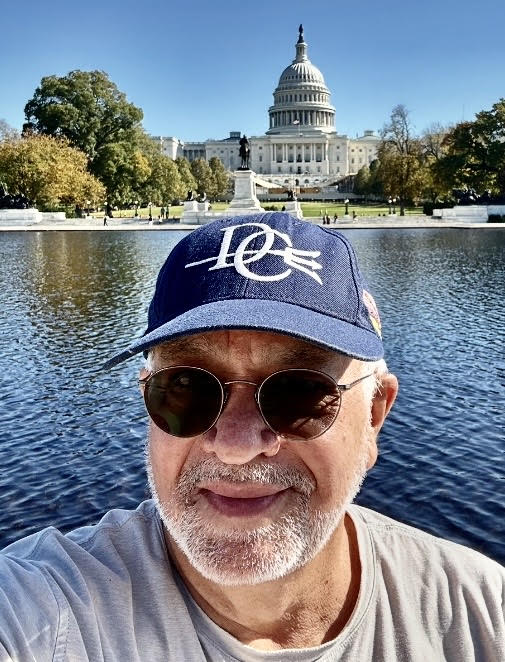
Samuel Sales Saraiva is a United States citizen, born in Brazil, an idealizer of projects, studies, and proposals aimed at social, institutional, and environmental challenges. He is the son of Captain Jairo de Freitas Saraiva, a veteran of the Second World War, and dentist Adamar de Paiva Sales Saraiva. He was born in Porto Velho, capital of the former Federal Territory of Rondônia, in the Western Amazon, in the early 1960s — a period when the Brazilian Amazon still preserved much of its natural characteristics and environmental balance.
Throughout his life, Samuel Sales Saraiva has maintained a consistent posture of independent civic participation, based on the conviction that the exercise of citizenship does not depend on electoral office or institutional position, but rather on the willingness of conscious individuals to reflect, propose ideas, and engage in dialogue with the institutions of their time.
This engagement began in Brazil, where he participated in public debate through studies and reflections aimed at institutional improvement, particularly in the areas of state organization, public responsibility, and the strengthening of democratic mechanisms.
Academic Background and Institutional Reference
Samuel Sales Saraiva studied International Relations at the Faculty of Political and Social Sciences of the National Autonomous University of Mexico (UNAM) and at the University of Brasília (UnB).
In the Brazilian capital, he completed the Diplomatic Law course taught by Professor and Ambassador José Osvaldo de Meira Penna, a diplomat, intellectual, and one of Brazil’s most respected thinkers in diplomacy, political science, and international relations.
This academic background was mentioned in an official speech by Senator Carlos Alberto de Sousa, later published in the Diário do Senado Federal on March 19, 1985 (Section II, page 0267).
This parliamentary record forms part of the historical archives of the Brazilian Senate and constitutes an institutional testimony of Samuel Saraiva’s participation in the political and institutional reflection environment of that period.
Summary of Conceived Projects
Among the many proposals developed throughout his trajectory, the following stand out:
• Mechanisms for containing forest fires in Brazilian biomes, especially in the Amazon and the Central-West.
• Intelligence and preventive security strategies.
• Assistance programs for chemical dependents focusing on social recovery.
• Humanization of public security.
• Strategies for the regularization of Brazilians residing abroad.
• Encouragement of community volunteer service and philanthropy.
• Political representation of Brazilians abroad.
• Institutional assistance for Brazilian communities outside the country.
• Review of international treaties relevant to national interests.
• Environmental awareness education in basic schooling.
• Oversight of Brazilian consular services by representatives of the National Congress.
• Unified identification registry within the Brazilian public health system (SUS).
• Strict oversight of the assets of public officials.
• Debate on the principles and limits of freedom of expression.
• Interconnection of the national water system with the Amazon Basin.
• Discussion on the use of polygraph testing in certain matters of public interest.
• Transparent distribution of natural resource royalties.
• The right to choose between conventional burial or cremation.
• Proposals aimed at global environmental protection.
• Educational programs on environmental preservation.
• Strategies to combat hunger.
• Proposals for preventing terrorist actions.
• Strengthening bilateral relations between Brazil and the United States.
• Academic merit credit for veterans of the United States Armed Forces.
• International standardization of medical curricula.
• An application for recording psychological abuse and violent behavior within the framework of the United Nations.
• Proposal to the International Olympic Committee encouraging donation programs for social victims and abandoned animals.
• Creation of a Permanent Political Advisory Council within the Brazilian Senate.
Historical Testimonies
Speeches recorded in the historical archives of the Brazilian National Congress mention several of these initiatives over the years, delivered by parliamentarians from different political currents.
Later, after moving to the United States, this posture of civic participation naturally extended to the American context.
Driven by the same spirit of democratic collaboration, Samuel began submitting reflections and suggestions on matters of public interest, including institutional governance, security, immigration, and international relations.
Some of these communications received formal responses from the Presidency of the United States, which are now preserved as documentary records of civic dialogue maintained across different administrations.
These communications do not represent political recognition or institutional affiliation, but rather constitute formal testimonies of the right and duty of every citizen to address public authorities with ideas and suggestions aimed at the common good.
Few individuals maintain, over so many years, a continuous posture of civic participation — writing, proposing ideas, and engaging in dialogue with institutions without holding public office, without seeking political prominence, and without any expectation of financial reward.
This same consciousness brings a quiet satisfaction for having honestly participated in the human dialogue, yet it also buries any vanity in the face of individual insignificance within the vast course of history.
And while these reflections accumulate, time continues its inexorable course — flowing rapidly and almost imperceptibly, awakening us to the inevitable certainty of the permanence imposed upon us.
Ultimately, it is simply the recognition of a basic truth:
Earth is our temporary home, and contributing to the improvement of collective life is a responsibility shared by all its inhabitants.
Record of Presidential Correspondence Received from the White House
George W. Bush — 12/15/2003
Al Gore — Vice President — 03/15/2007
George W. Bush — 12/15/2003
Barack Obama — 04/07/2016 — 01/10/2017
Joe Biden — 03/02/2026
Donald J. Trump — 03/02/2026
Journalism Activities
In the United States, the country that granted him citizenship, Samuel began journalistic activities in 1992, accredited by the New York State Police Department, writing for a community magazine.
After moving to Washington, D.C., in 1994, he became affiliated with the National Press Club and the National Association of Hispanic Journalists.
Later, he accepted an invitation from journalist Carlos Sperança to serve as the United States correspondent for Momento Brasil magazine and for the portals Gente de Opinião and Rondônia Web.
In October 2000, after launching US Latin Magazine as editor, he participated, at the invitation of the White House during the Clinton administration, in a conference on “The Growing Importance of the Americas and the Growth of the Latino Population in the United States.”
Thematic Axes of Essays and Reflections
Samuel Sales Saraiva has published numerous essays addressing central questions of contemporary civilization.
Human Consciousness and Civilizational Evolution
• The Rise of Consciousness: Why Humanity Destroys Before Thinking
• The Astonishing Decline of Human Consciousness
• Awakening of Consciousness: Between Factual Reality and the Improbable Promises of the Afterlife
• Humanity: Between Faith That Obscures and Consciousness That Awakens
• Beyond the Veil: Consciousness Remains and Energy Knows No End
• Ignorance Elevated to the Status of Art by Enthusiastic Idiots
• The Lessons of War Should Already Have Been Learned by the Brutalized Elites of the Planet
Justice, Institutions and Public Responsibility
• When Justice Is Reduced to Legal Abstraction and Dissolves into Privilege
• When Justice Bows to Money and Disregards the Truth
• External Oversight of the Judiciary: A Warning Presented to the Brazilian Senate in 1997 and Ignored
• From Freedom of Expression to Institutional Responsibility
• Complaint to the U.S. Department of Justice Regarding Fraudulent Immigration Lawyer Practices
• Non-Lethal Solutions Could Reduce Violence and Recognize Responsible Police Action
Faith, Religion and Power
• The Normalization of Servitude: Between Material Exploitation and the Fraud of Faith
• The Shameful and Profitable Industry Created in the Name of God: Deception, Death, Tithes and Tax Privileges
• When God Becomes a Threat: Divine Terrorism as a Tool of Control and Exploitation
• Asking God for Help Through Prayers and Supplications Means Underestimating His Omniscience
• The Dark Side of Faith in a Promiscuous Relationship with Political Power
• From Superficiality to the Art of Not Understanding: Faith, Love and Shallow Convictions
• Answer Me, God
Existence, Nature and Philosophical Reflection
• Nature Teaches in Silence — Those Who Wish to Learn Will Understand
• Where Conquest Meets Silence
• The Crossing Between Reason and Delirious Imagination
• Silence, Fear, Reason, Solitude and the Abyss
• Pursued by Destiny, Welcomed by Silence
• Between Light and Shadows, We Inhabit the Present on the Path Toward the Infinite
• When Existence Challenges Dogmas
• It Is Not Error That Ruins Us, But Cowardice That Prevents Us from Daring
• It Is Not Revolt. It Is Indignation and Lucidity
• Water, Consciousness and Survival
• The Banality of Cruelty
• The Silence That Buries the Infinite Within Us
These texts reflect a recurring line of thought in his work: the defense of reason, critical consciousness, and human responsibility as foundations for a more just and civilized coexistence.
Diversification and Survival
Like many immigrants, Samuel diversified his professional activities throughout his life.
In addition to journalism, he worked in the residential remodeling sector, obtaining an official license from the State of Maryland through the Maryland Home Improvement Commission (MHIC).
He also received certification as a Minority Business Enterprise from the Capital Region Minority Supplier Development Council and from the Maryland Department of Transportation.
Despite working in different fields, he maintained humanitarian concerns.
In 2018, he proposed a project for the construction of protective bunker-style shelters near private residences in the Washington metropolitan area, intended as refuges in cases of natural disasters or extreme emergencies.
The project did not advance due to the absence of investment capital.
Technological Initiatives and Inventions
This year, Samuel Sales Saraiva also dedicated himself to developing technological solutions aimed at public safety and energy efficiency.
As an inventor, he filed two provisional patent applications with the United States Patent and Trademark Office (USPTO).
The first project consists of a mechanical mitigation and protection system against snow accumulation on rooftop solar panels, designed to reduce energy-generation losses and structural damage in regions subject to severe winters.
The second concerns the Integrated Vehicular Speed Compliance, Preventive Alert, and Conditional Access Recording System (DSCPAS).
This technological architecture is intended to detect real-time speed exceedance based on georeferenced legal limits, issue preventive alerts to the driver, and allow conditional recording of data for road safety analysis and potential use by insurance companies.
Sport, Sea, and Balance
Among the activities that are part of his daily life, Samuel Sales Saraiva cultivates a deep appreciation for sports and the outdoors, finding in swimming, cycling, motorcycling, and sailing forms of leisure, physical discipline, and personal balance.
He is also certified by the Brazilian Navy with the CHA – Amateur Skipper License (Registration # 023A2023001429), which authorizes the operation of recreational sailing vessels in coastal ocean navigation. This license benefits from international reciprocity and is recognized in several countries that are signatories to international maritime conventions.
At sea, as in life itself, Samuel finds a space for silence and reflection — where the open horizon invites contemplation, freedom, and an awareness of the transience of time.
Final Synthesis
Perhaps, in a distant — and perhaps unlikely — future, humanity will reach a level of lucidity in which reason prevails over fantasy and verifiable facts overcome archaic beliefs that have fueled division and conflict for centuries.
When that level of consciousness is reached, peace will no longer be merely an abstract ideal.
Human beings, having matured emotionally and rediscovered empathy and solidarity, will learn to resolve conflicts without first destroying thousands of lives only to later seek solutions through dialogue that reason had always made possible.
At that stage of civilizational maturity, humanity will understand that good and evil are not external forces competing for the human soul, but choices produced by human consciousness itself.
And perhaps it is precisely through this recognition that humanity will finally begin to evolve.
“True citizenship is not a paid position — it is a consciousness.”
_____________________
Updated in March 7, 2026