
.
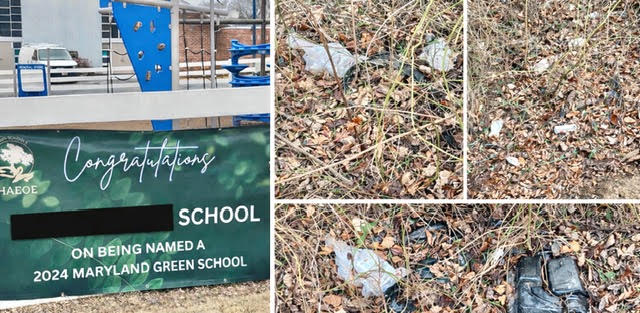
Not far from a banner celebrating environmental excellence at a private Christian school in Montgomery County, just outside Washington, D.C., the surrounding vegetation tells a very different story.
Among the bushes lie plastic bottles, disposable packaging, and other litter quietly scattered across the ground.
The contrast is striking — and requires little explanation.
On one side stands the institutional language of sustainability. On the other, the everyday reality that seems unable to keep pace with that rhetoric.
Ironically, the same school — whose saint’s name I prefer not to mention — regularly organizes spring environmental outings for its students. These activities are designed to encourage ecological awareness and respect for nature.
Perhaps there is an even more meaningful educational opportunity waiting just outside the classroom door.
During these outings, a few minutes could be dedicated to collecting litter around the school grounds. Students could take pride in leaving the place cleaner than they found it, perhaps even receiving symbolic recognition for their contribution.
Beyond the obvious environmental lesson, such an exercise would nurture something equally valuable: civic responsibility and the spirit of volunteerism — essential qualities in the formation of thoughtful, engaged citizens.
Because environmental education is not built on banners, certificates, or institutional slogans.
It begins with small, concrete actions — the kind that shape habits, transform shared spaces, and cultivate responsibility for the world we inhabit.
If a contrast like this can be observed in the capital region of one of the most developed nations on Earth, one cannot help but wonder about the scale of environmental neglect in many other parts of the world, where landscapes increasingly resemble open dumping grounds.
In such environments, wildlife inevitably pays the price.
Birds, squirrels, ducks, raccoons, foxes, deer, and countless other creatures move silently through these spaces we share with them. Some leave behind small but tragic signs of suffering — faint traces of blood in their tracks after being injured by broken glass, shattered bottles, or sharp metal fragments discarded carelessly among the vegetation.
This is not merely a matter of aesthetics or urban tidiness.
It is a quiet assault on the fragile balance of life.
Nature has welcomed humanity with remarkable generosity.
Forests, rivers, animals, and landscapes have sustained us long before we learned to call ourselves civilized.
The question is no longer whether nature has done its part.
The question is whether we are capable of doing ours.
P.S.:
Perhaps on a future ecological outing organized by the school, in addition to the lessons about sustainability and environmental awareness, students might take a few minutes to collect the litter scattered in the vegetation around the campus itself. It would be a simple opportunity to bring practice into alignment with principle — and perhaps turn a theoretical lesson into a quiet, meaningful gesture of respect for the environment and for the small animals that live there.
_______________
Reader Comment
What makes this article particularly effective is its restraint. Rather than relying on accusations or exaggeration, it simply presents a contrast that speaks for itself.
The presence of litter in the vegetation surrounding a place that publicly celebrates environmental values reveals a deeper issue: the frequent gap between what institutions proclaim and what is actually practiced in everyday life.
Equally important is the reminder that this negligence does not affect only the landscape. Small animals — birds, squirrels, ducks, raccoons, foxes, deer, and many other creatures — often become the silent victims of human carelessness.
Perhaps the most valuable point raised by the article is that environmental education does not begin with speeches or official programs. It begins with something far simpler: caring for the space we occupy.
A thoughtful and timely reflection.
— Fatima Arbidron
Olney, Maryland