
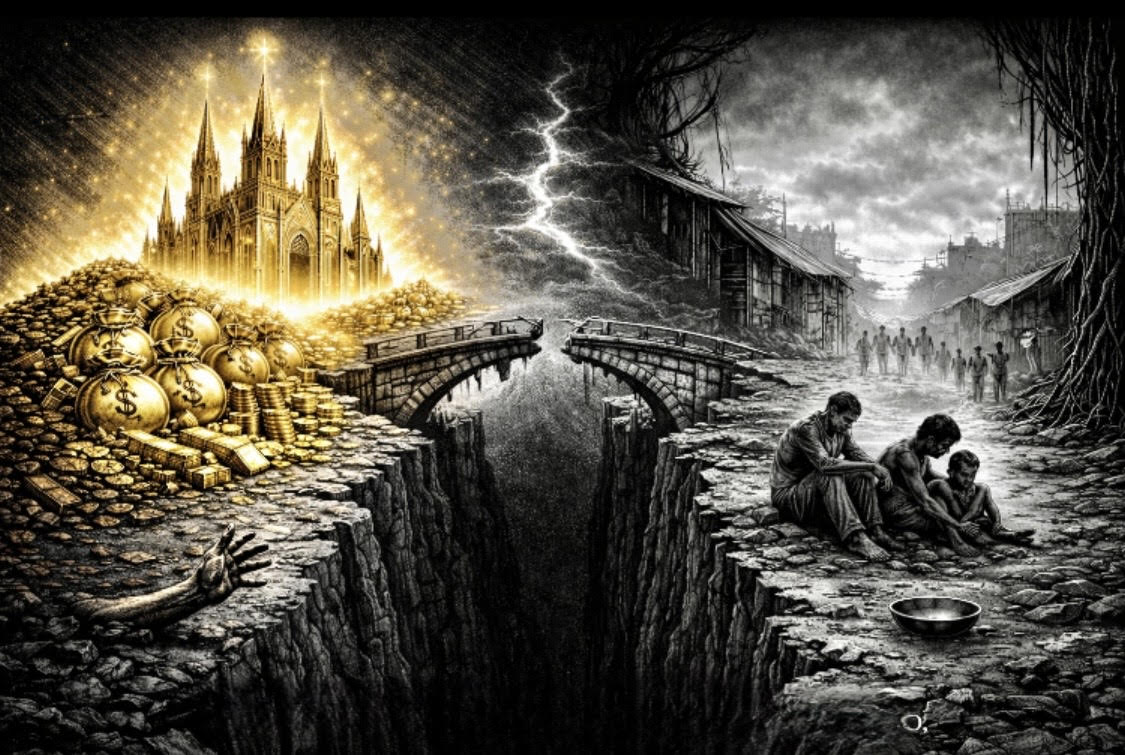
Between the altar and hunger: sincerity is treated as an attack, compassion as a threat — and ignorance as a virtue
Based on historical records, what is the estimated death toll associated with conflicts waged “in the name of God” — the so-called “holy wars” — and to what extent does this concept, when instrumentalized as an absolute moral authority, contribute to the suspension of reason, the legitimization of cruelty, environmental destruction, and the perpetuation of extreme inequality? Furthermore, how can one explain the accumulation of religious wealth on Earth — often valued in the trillions of dollars — in contrast with the very teaching attributed to scripture (“do not store up treasures on Earth”), especially when millions remain trapped in chronic misery and succumb to hunger and abandonment? Considering that charity and compassion toward those in need should, in practice, be the central moral purpose of religious organizations that still enjoy tax incentives and other privileges, how can it be justified that many of these institutions — diverted from their own philosophical foundations — have turned their mission into a commercial model that sells health and education, services from which the poorest are demonstrably excluded, while expanding a highly profitable enterprise and still imposing upon the population the heavy burden of a “divine tax” called the tithe, added to constant offerings, sustaining promises of spiritual reward that are often treated as mechanisms of exploitation and moral fraud?
The estimate of deaths resulting from conflicts fought “in the name of God” — or legitimized by the idea of sacred war — cannot be fixed with absolute precision, because history rarely offers a single, isolated causal factor. Still, historical records allow us to state with reasonable confidence that the total reaches into the tens of millions, and may approach hundreds of millions when we include wars, persecutions, sectarian massacres, and domination processes sustained by religious discourse as moral authorization. The essential point is not only the number, but the mechanism: when a conflict is stamped as “holy,” it stops being treated as a human error and begins to be seen as a “duty,” which suspends doubt, disables empathy, and turns violence into virtue.
In this sense, the concept of God — when used as a seal of unquestionable authority — functions like a collective moral hallucinogen: not because it manufactures bombs or weapons, but because it can reshape human judgment, making acceptable what, under rational conditions, would be recognized as monstrous. The idea of a “divine mandate” often produces a psychological shield that replaces responsibility with obedience, conscience with submission, and ethics with fear. As a result, the mind stops asking “is it right?” and begins asking only “was it commanded?” — opening the door to fanaticism, dehumanization of the other, endless wars, and, inevitably, the environmental destruction that follows any war machine.
Yet the most glaring modern contradiction is not found only in war: it is also found in the economy of the sacred. Religious organizations that preach — in their “sacred” records — that one must not accumulate treasures on Earth have come to concentrate wealth and influence that, in many cases, reach values in the trillions, while millions live in chronic poverty, die of hunger, or survive without real access to health, education, and dignity. And then the unavoidable moral question arises: if compassion and charity should be the practical nucleus of any religion, how can it be justified that institutions still protected by tax incentives and privileges have drifted from their ethical purpose and, in part, transformed into commercial enterprises — selling “healing,” “prosperity,” and even “education” as a product, precisely where the poorest are, in practice, excluded?
The distortion grows worse when this model not only expands, but sustains itself through a mechanism that can be described as an emotional tax disguised as faith: tithes and offerings, demanded under moral pressure, spiritual fear, or the promise of reward in some “higher plane.” Under this structure, the sacred ceases to be a path of human elevation and becomes an instrument of control, where hope is commercialized, and guilt is administered, while the believer funds institutional expansion and receives, in return, promises that are often impossible to verify — and which, when used as manipulation, resemble a form of moral fraud.
In summary, the historical and social responsibility does not lie in a “metaphysical God” that no one can prove, but in the human use of that concept as a tool of power. When faith becomes armor against reason, and religious rhetoric becomes a strategy of domination, the recurring result is always the same: legitimized violence, normalized mental stagnation, preserved inequality — and, often, suffering on an industrial scale. The problem is not spirituality as an intimate search; the problem begins the moment the sacred becomes currency — and the human conscience becomes hostage.
A finding — the inevitable synthesis
In the end, what is revealed is not a spiritual mystery, but a human mechanism: when God becomes an absolute argument, reason is dismissed — and everything becomes permissible.
History records the price of that moral license: wars waged “in the name of the sacred,” massacres justified as duty, and humanity repeatedly seduced by the idea that killing can become virtue when wrapped in faith.
And when the altar turns into a business, the drama is complete: the sacred becomes commerce, hope becomes currency, and misery remains the ground on which the people kneel — not out of faith, but out of lack of alternatives. The very system that promises salvation often imposes burdens: tithes, offerings, fear, guilt, and promises that can never be held to account.
Thus, what should be compassion becomes control.
What should be charity becomes property.
What should be light becomes smoke.
Because when the sacred becomes business: faith becomes a weapon — and a vault.
And then comes the question no one should ignore: faith or moral extortion? The tithe, power, and hunger.
Meanwhile, the paradox that humiliates the conscience continues to grow: consecrated delirium — “holy” wars, trillion-dollar wealth, and a people left in misery.
And if anyone still tries to gild the narrative, reality responds with a sentence that demands no opinion, only honesty: “do not store up” — they store up.
For the uncomfortable truth is this: God, as a social sedative, often serves to produce the suspension of reason in the name of the sacred.
And from that suspension comes the modern monstrosity: wars in God’s name, profit in faith’s name.
In the end, the moral balance is impossible to hide:
Sacred for the pulpit, hunger for the street — faith kidnapped by power.
And what is sold as eternity often merely postpones earthly justice.
Because for many, this is what remains: other people’s paradise — spiritual promises, real poverty.
_______________
Comments:
This text exposes the absurd: mental limits were imposed, injustice was normalized, and submission was labeled as morality. Those who feel threatened aren’t reacting to the tone—they’re reacting because truth dismantles the system. Oliver Norton – Los Angeles, CA.
The “Sermon on the Mount” from matthew has been described as Jesus’ “Spiritual Manifesto.” A shorter version of it, written 100 years or so later by writers named “Luke” is directed more to a general (probabt Jewish) crowd whereas the longer Matthew verskion is more “for insiders only” – i.e. members are the soob-to-be distinct jewish sect of rabbi-Jesus follower. Of the many “uses” the Church Establishments over the years has made of these few words concerning the relative value of earthly vs heavenly “treasures” surely the most obvious and common was the clever-manipulation, the slight of hand, still used today by televangelists: “Jesus says money is Bad – so give it to The CHURCH (that is, to me)”. Rationales include “Invesment” – watch god’s love grow! by which is meant – watch how many mercedes benzs your paster can get! And also the pseudo-spiritual trade-off: “the more you give to God in This world the more He will Love you in the Next!”
The genius behind these Sermons (on the mount in Mat, and On the Plain in Luke) are just like most political speeches: everyone in audience can find some meaning in them. But the Church especially LOVED the “convertability” thing where congregants should trade in ALL their material wealth (+$$$) for “heavenly/eternal favor” (no cost!). Whether the investors have actually EVER received anything in return is, also, a matter of faith. Feeling Good about the trade, though, may justbe worth the price – compare that to the “thrill” of gambling as an equally strange type of investment.