
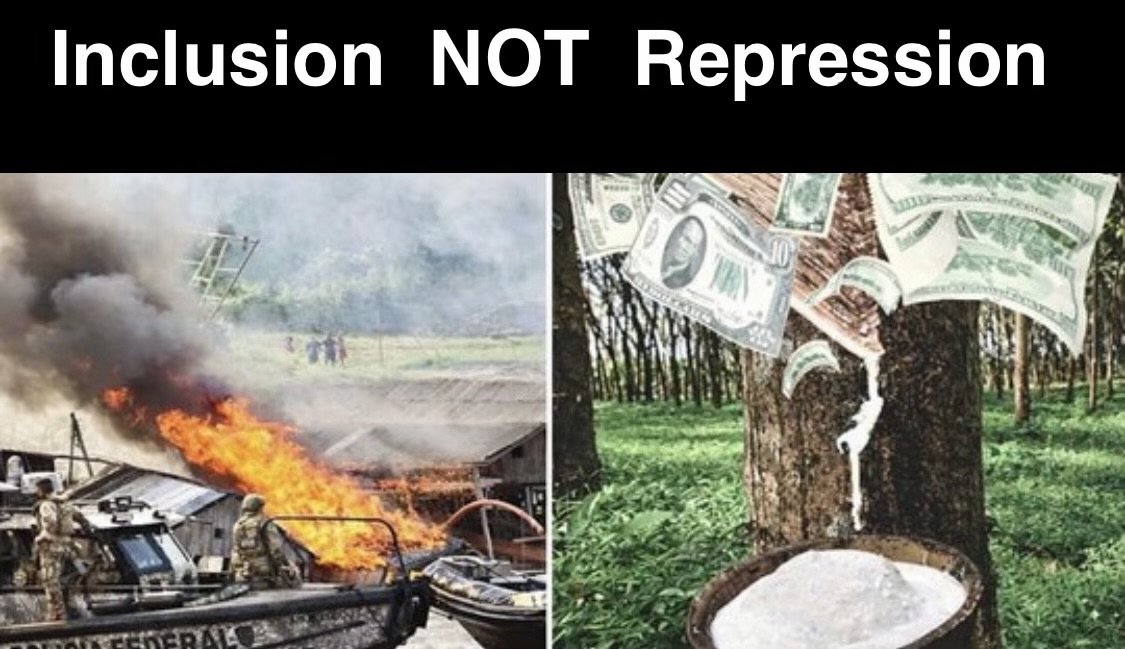
Burning machines does not save the Amazon: the moral and political failure behind the official narrative
The recent glorification of repressive operations against illegal mining in the Amazon, celebrated as major environmental victories, reveals more about the fragility of the Brazilian state than about its real capacity to protect the rainforest. By turning the destruction of machines, barges, and structures into a media spectacle, public authorities present striking numbers and convenient headlines while avoiding the essential debate: why the problem persists and who failed to prevent it.
Repression in isolation may generate visual impact and momentary applause, but it does not produce environmental justice, social stability, or lasting preservation. When portrayed as a successful environmental policy, it becomes a dangerous inversion of values.
It is reasonable to assume that such assessments will not be received with sympathy by Brazilian authorities. However, this discussion does not seek political approval, but responsibility. When significant volumes of resources are mobilized in the name of environmental protection and repeatedly fail to deliver proportional and verifiable results, silence ceases to be prudence and becomes negligence. Alerting donors to the structural risk that well-intentioned funding may be feeding endemic corruption is not an act of hostility toward a nation, but a duty to transparency, sound governance, and the citizens whose contributions finance these programs.
Conclusion
Burning machines does not save the Amazon. Nor does the continued allocation of financial resources into environments where transparency is structurally weak, oversight mechanisms lack independence, and accountability systems fail to deliver measurable results. Repression without intelligence and funding without verifiable governance do not constitute environmental policy—they signal its absence.
Logic, reason, and accumulated empirical evidence demand a more cautious and disciplined posture from international donors. Recurrent assessments of institutional performance, public integrity, and anti-corruption controls point to persistent deficiencies in enforcement capacity, fragmented oversight, and limited effectiveness of compliance mechanisms across multiple sectors of the Brazilian public apparatus.
Under these conditions, trust cannot be presumed—it must be demonstrated through independent audits, continuous monitoring, clear performance indicators, and effective accountability mechanisms. Sovereignty cannot substitute for transparency, nor can moral urgency override evidence-based due diligence.
The Amazon does not require symbolic gestures, rhetoric, or unconditional financial flows. It requires institutional intelligence, state strengthening, rigorous accountability, and development strategies grounded in traceable results.
Finally, an unavoidable logical consideration must be stated: no nation should be required to pay for destruction carried out in foreign territories by the actions of its own people. The solution is neither complex nor ideological. Societies must educate their populations to understand that the degradation of their own biological and natural heritage inevitably leads to scarcity, hunger, and instability. History shows that when environmental collapse undermines food security, sovereignty itself becomes fragile. In extreme scenarios of scarcity, space opens for external intervention, and powerful nations tend to assume control over strategic natural resources under the argument of preservation and stability. Environmental responsibility, therefore, is not merely an ethical choice—it is a condition for survival and self-determination.
In conclusion, the evidence points to a structurally self-reinforcing dynamic in which environmental degradation is converted into a continuous source of financial flows; these flows sustain institutional architectures; and such architectures become functionally dependent on the persistence of the very conditions that legitimize their existence. This dynamic reflects a classic pattern of path dependence and institutional moral hazard, whereby a prevailing culture of accommodation—discursively framed as virtuous engagement—operates as a mechanism for stabilizing the status quo, systematically displacing transformative public policies and inhibiting the emergence of genuinely preventive and sustainable solutions.