
.
I awaken suddenly, pierced by the awareness of the fleeting nature of human existence, and feel an urgency to write — like someone unwilling to waste the sparks of lucidity that break through the rarefied silence of the early morning hours.
Perhaps insomnia — that unwelcome visitor that arrives when the body pleads for rest — is, paradoxically, one of the few moments in which consciousness finds enough quiet to listen to itself, free from the relentless noise of daily urgencies.
As time slips away, between ecstasy and distraction, we contemplate a universe whose beauty is revealed to us only at an infinitesimal distance from our own eyes. Few are willing to search for the meaning of existence beyond dogma; others become lost in conjectures they attempt, in vain, to materialize; while multitudes find comfort in the improbable promise of paths leading to eternity — to a reunion with those with whom they shared the earthly journey, yet did not always know how to honor with appreciation and fraternity.
All of us, without exception, have been granted the rare privilege of entering this dimension to live an experience that is, in essence, truly celestial. Even so, few recognize the magnitude of the human condition — not in the mystical sense of the “divine,” but in the cosmic sense: that of inhabiting this celestial body we call Earth.
The mind fears the passage because it longs for permanence. Reality continues because it unfolds through transformation. Between these two movements, anxiety emerges: the desire for stability confronted by the inevitable vocation of change — the silent dialogue between the friction of desired permanence and the inexorable metamorphosis, imperceptible to intellects shrouded by the shadow of fear, which suffer in anticipation before the scarcity of inner light.
To acknowledge — with fear or despite it, attached or not to the continuation of this experience — that every cycle finds its end, especially the biological one, may inaugurate a discreet and serene form of inner peace.
Persisting in the attempt to prolong what has already been exhausted is often the silent root of human suffering. By insisting on continuing what has already come to an end — whether a cycle, a phase, or a relationship — we feed the illusion of permanence and, at the same time, imprison freedom in its most essential spontaneity. This applies, in a particularly sensitive way, to human relationships which, like all living things, are also consumed after fulfilling their time and purpose. Knowing how to leave them behind does not imply denial or ingratitude, but rather the recognition of impermanence as a natural condition of existence. Allowing new paths to open requires that we not force what is, by nature, untamable — the soul — whose permanence finds legitimacy only when it remains enchanted, not when it is held by duty, by humiliating and unnecessary compassion, by habit, or by fear of absence.
When enchantment fades, commitment loses its meaning.
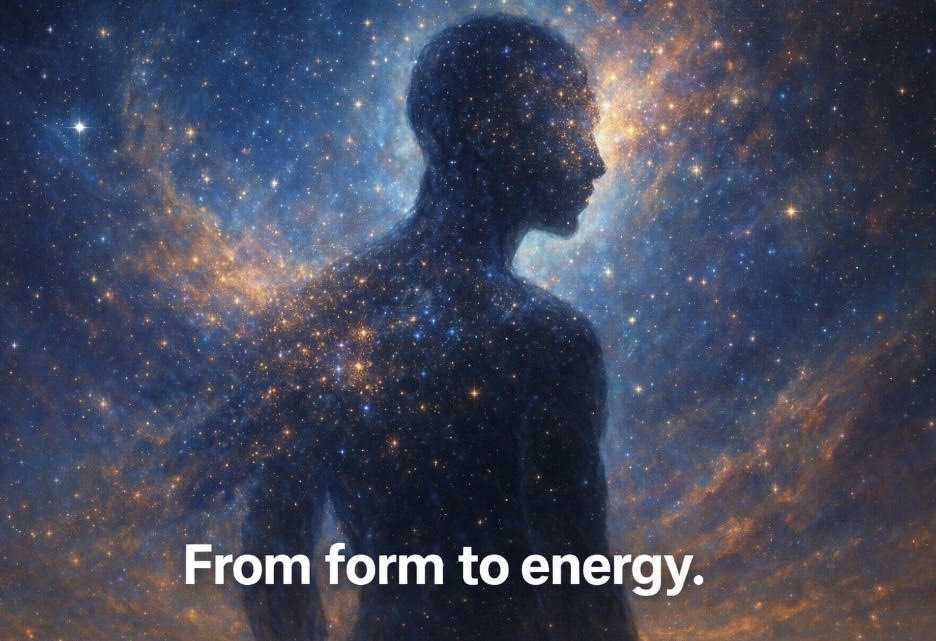
To admit, with clarity, that at the end of this passage nothing we now conceive as material will persist in the form we know — and that we will be, at best, energy dispersed within the fabric of the cosmos — does not impoverish existence; on the contrary, it dissolves unsustainable expectations and emancipates us from the culture of fear and the sociocultural constructs that imprison the mind from the moment we were cast into an immense bubble incapable of preparing us to understand finitude realistically.
To face the end not as failure, but as an intrinsic condition of the very phenomenon of existence, allows us to receive it with lucid resignation — and even with gratitude — mitigating the suffering amplified by the fear of death and by promises of permanence that could never be fulfilled.
Time — that silent sovereign which bends the powerful and levels the wealthy and the dispossessed, materialists and spiritualists alike — reduces the arrogance and beauty standards of superficial minds to contemptible rags at the threshold of life’s exhaustion.
Even so, the delusions of streets of gold, rivers of milk and honey, celestial mansions, and triumphant trumpets persist — as if spirits could enjoy the same privileges that make sense only within this physical dimension.
Nothing remains — and within this lies not a threat, but a quiet form of ontological mercy.
Time advances, relentlessly, with every irretrievable second. And between days of rain and storm, winds, cold and heat — or beneath the sun, to the sound of innocent birds and the laughter of children echoing through immensity — the cycle of life repeats itself in this extraordinary setting where we waste opportunities that arise like nuggets or precious stones: the immeasurable treasure of human interaction, often buried beneath inertia and the vicious routine that consumes what we have that is most precious — life itself.
To understand cycles is not to resign oneself to fate, but to free oneself from the compulsion to freeze what is, by nature, flow.
Distracted, we follow our path until the final moment — staggering like the intoxicated through a narrow alley between reason and madness, between obedience and the transgression of imaginative norms often devoid of ethical, moral, or spiritual meaning, interpreting reality from a limited and sectarian angle of knowledge, as though other readings of the world were not possible.
Perhaps, if we were willing to understand the broader meaning of existence — free from the contamination of ancestral narratives, collective delusions, and improbable promises — we would realize that much of the fear surrounding departure does not arise from death itself, but from the culture of attachment to what was never ours to eternalize.
Reflecting on the fleeting nature of human existence is, therefore, also a way of not wasting those precious sparks of lucidity that, like fireflies, illuminate the mind — inviting us to value what we have today, and what is, in fact, real.
Between the desire for permanence and the inevitability of transformation, lucidity consists in not suffering for an imagined eternity that escapes us in the present — the only moment in which all existence occurs, without converging toward heavens or hells forged by delirious minds and perpetuated by others who, in the same way, feed this endless chain of fantasies.
___________
Comments
This article, faithfully illustrated in the accompanying image, does not seek to suggest transcendence through mystical means, but rather to invite contemplation of the human condition in the face of the vastness of the cosmos. In its restraint, it synthesizes ephemerality, consciousness, and universal scale without resorting to religious symbolism — precisely as the text proposes in situating human experience as a brief flash of lucidity within the silent immensity of the material plane. A. Monaigne – Vancouver, CA