
SILENCE, FEAR, REASON, SOLITUDE, AND THE ABYSS
There are moments when the world doesn’t scream — it simply insists, or falls quiet.
It insists with its constant hum, the speed of certainty, the shine of empty gestures. And yet, inside, everything feels still. Not a peaceful silence, but a silence of absence — as if humanity had learned to speak without listening to itself.
Perhaps it’s because, deep down, we all feel the same thing: life begins like a dawn — wide, innocent, filled with promises — and moves, without exception, toward its infallible twilight. Between these two extremes, we cross time trying to make meaning of what passes, trying to hold on to what should never be lost: presence, truth, dignity, and hope.
We are many. But we do not always find one another — or truly remain together.
Modern solitude is not the absence of people; it is the absence of presence.
It is being surrounded by voices and still having no witness. It is offering your own truth and watching it returned as if it were inconvenient — or uninteresting. It is being deep in a time when almost everything has been designed to float.
And then, with a lucid sadness, we realize: there is an abundance of words and a scarcity of conviction. There is rhetoric of love everywhere — beautiful phrases, touching teachings — but few hands willing to carry the weight of what is being said. The world has learned to memorize light without igniting the heart.
TRUTH IN AN AGE OF NOISE
Noise — fleeting entertainment — is not merely sound: it is organized distraction.
It is a sophisticated way of preventing the essential from reaching us. It is the politics of shallowness, the worship of speed, the addiction to what only appears beautiful. Noise occupies the space where conscience should be able to breathe.
And so truth is pushed into a corner — not because it is false, but because it is uncomfortable. Because truth demands posture. It demands renunciation. It demands choices. And choices, today, seem to cost more than people are willing — or able — to pay.
Falsehood, by contrast, is generous: it embraces without asking. It comforts without responsibility. It seduces without consequence.
And that is why it thrives.
LUCIDITY AS COMPANIONSHIP
Some believe lucidity is a burden.
But in truth, lucidity is shelter. It does not remove us from the world — it keeps us from being swallowed by it.
Discernment is freedom: it releases us from the dogmas we adopt out of sympathy, and it pulls us out of the sameness that blocks inner evolution, in a world still full of minds trapped and confused by unreasonable illusions.
On certain days, introspection stops being retreat and becomes resistance. Not an escape, but an act of dignity: the quiet effort to remain whole. Because living, at times, is simply this — keeping one’s conscience awake while everything around seems anesthetized.
And at that point, one realization becomes stronger: lucidity is also a form of companionship. It proves there is still humanity wherever reflection exists, and there is still a path wherever truth remains. Even if no one applauds. Even if no one notices.
I do not write in search of applause — that shallow caress of foolish vanity, stroking an impoverished ego on the illusory stage of the senses. I write for another reason: because perhaps someone will read this and not feel alone. Perhaps someone will recognize, behind these words, the same unrest — the feeling that consciousness, instead of evolving, has regressed under the weight of shine, moral luxury, and spectacle.
WE ARE NOT ALONE — ONLY OUT OF SYNC
Perhaps the truest sentence is also the simplest: we are not truly alone — only out of sync.
Out of sync in time, in haste, in the excess of noise. Out of sync because life became a corridor and we forgot to look into each other’s eyes.
And still… this does not have to be a verdict. It can be an impulse.
It can remind us that bridges are still possible — intelligent convergences, encounters that preserve honesty of thought and the logic of genuine perception — without drama, without theater, without cowardice, without betrayal, but with the serene authority of what is simply sensible.
Solitude is not proof of abandonment. Sometimes it is only the interval life creates before the reunion with what truly makes sense.
THE DIGNITY OF THE REAL
There is a kind of beauty that deceives — and a beauty that sustains and fascinates.
The first shines; the second remains.
The first seduces; the second transforms.
The first needs an audience; the second needs neither applause nor approval.
The dignity of the real lives in that silent beauty: the kind that cannot be sold, that does not display itself, that does not scream to exist by feeding unsustainable vanity.
And that is precisely why it has become rare.
Glamour is an anesthetic. It creates the sensation that we are living intensely, when in fact we are only avoiding emptiness. Appearances are a sophisticated mask: they make us look whole, but demand the price of depth — and can wound the soul.
The real, on the other hand, requires courage.
And every true courage carries something spiritual — not in the religious sense, but in the human sense: the strength to sustain and honor what cannot be bought.
WHEN CONSCIENCE STILL SHINES
Humanity often walks as if crossing a fragile bridge over an abyss.
On one side, reason; on the other, madness. And between them, the thin line where we stumble — sometimes out of ignorance, sometimes out of vanity, sometimes out of convenience.
The most frightening thing is not the abyss itself.
It is the inversion of values that makes us call virtue what is escape; freedom what is addiction; authenticity what is brutality; liberty what enslaves; happiness what is mere distraction.
And then we are covered by a ragged mantle of disgust and shame — a shame that tries to hide, but fails under the light within. Because conscience, even weakened, still shines. And when it shines, it hurts. And when it hurts, it means it still exists.
Moral pain is proof that something is still alive — sensitivity.
And as long as something is still alive, there is possibility.
THINKING BEFORE CHAOS
We cannot stop the insane march of those who drive “civilization” toward chaos. It advances like a current.
But perhaps we can understand it — and suffer less from what impacts us and remains beyond our control.
Many tragedies are not surprises. They are predictions ignored.
Lack of depth does not charge you immediately — it charges interest in the future.
The recurring mistake is to think only after choosing chaos too quickly, impulsively.
When intelligence was meant to reverse that order: to think first, and prevent the damage — to ourselves and to others — that lucidity makes avoidable.
Because life does not demand perfection from us. It only demands that we be honest enough to learn from lessons that repeat themselves — before it is too late.
CONCLUSION
In the end, perhaps meaning is not found in defeating the world, nor in convincing crowds. Perhaps it lies in crossing existence without abandoning what is essential: truth, sound judgment, responsibility, and a kind of delicacy that does not need an audience to exist.
We are not alone.
We are only out of sync.
And that realization, far from paralyzing us, can — on the contrary — strengthen in us the desire and the reason to continue with dignity: from dawn to twilight, until the inevitable conclusion of physical existence, which is not an absolute end, but a threshold into a spiritual existence that continues according to the elevation we have earned on this plane — revealed, with clarity, through the actions, good or evil, dignified or unworthy, that we choose to practice.
Because when everything passes, what remains is what should never have been negotiable: the value of keeping the conscience lit.
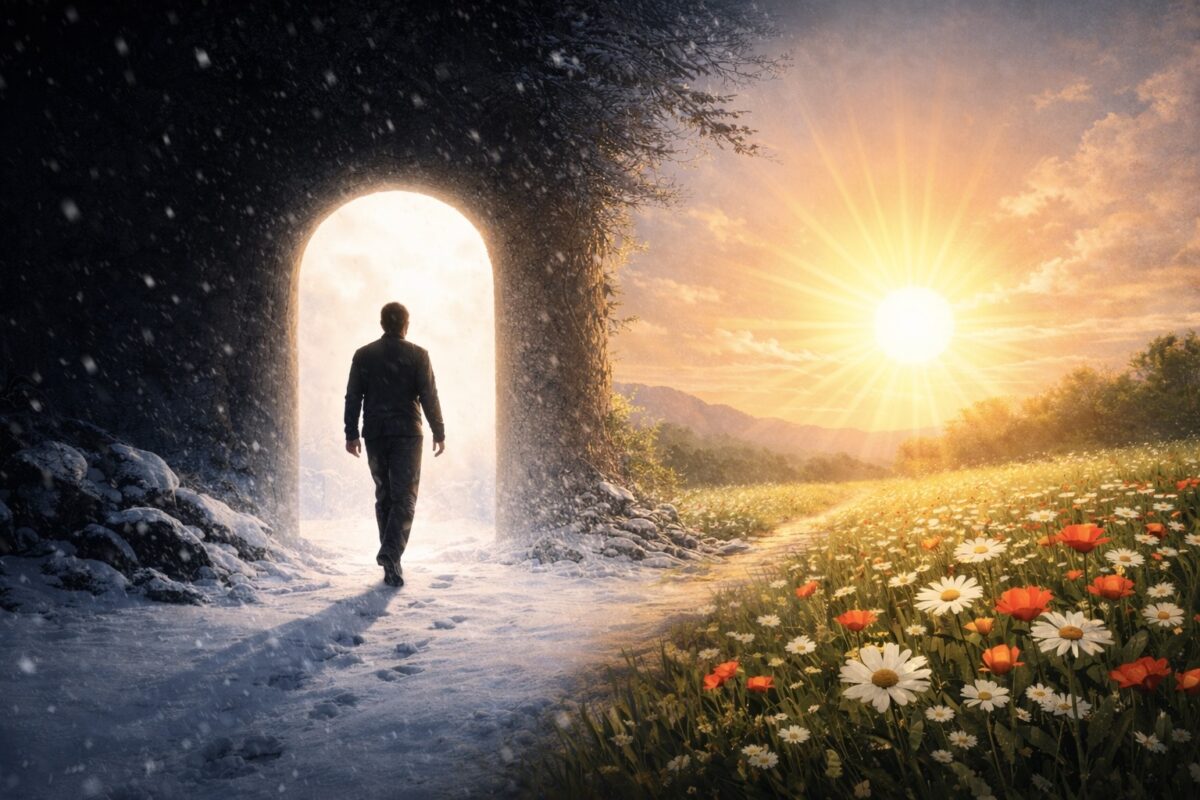
In the restlessness of solitude, under the whistle of icy winds that lash winter nights, the inner dialogue takes place — and within it a silent certainty is revealed: soon, spring will arrive, luminous, to make the soul itself bloom in an existential rebirth.
Perhaps life asks only this of us: to recognize the intact courage still living within us and, with it, to continue — free — in the direction of the destiny that awaits us.
______________
Comments:
“I admire and value the talent of my friend Samuel Sales Saraiva and, for that reason, I share here a glimpse of his enviable inspiration as a writer. You are a rare, unexpected talent. I truly admire your competence. You write like very few. Congratulations.”
Álvaro Dias — Brazilian political leader
“Senator, yes — it’s spectacular. Samuel Saraiva pulled this text straight from his depths, from his soul.”
Cris Rodrigues — Public Servant, State of Paraná
“I cried from beginning to end. I felt as if time had passed while I was merely surviving—too busy pleasing others and absent from myself. I realized how little I embraced myself, how often I postponed my own needs. This reading is a painful, but necessary mirror. Very reflective. Excellent.”
Esmeralda Salles — PhD in Psychology, Rio de Janeiro
“Wow! This article is one to read and reread, so we can understand the dogmas of life. Samuel Saraiva is always delighting us with flawless texts.”
Maria Cristina C. Rodrigues — Teacher, Curitiba
“Excellent reflection!!!!”
Sílvio Persivo — PhD Professor of Economics, UNIR