
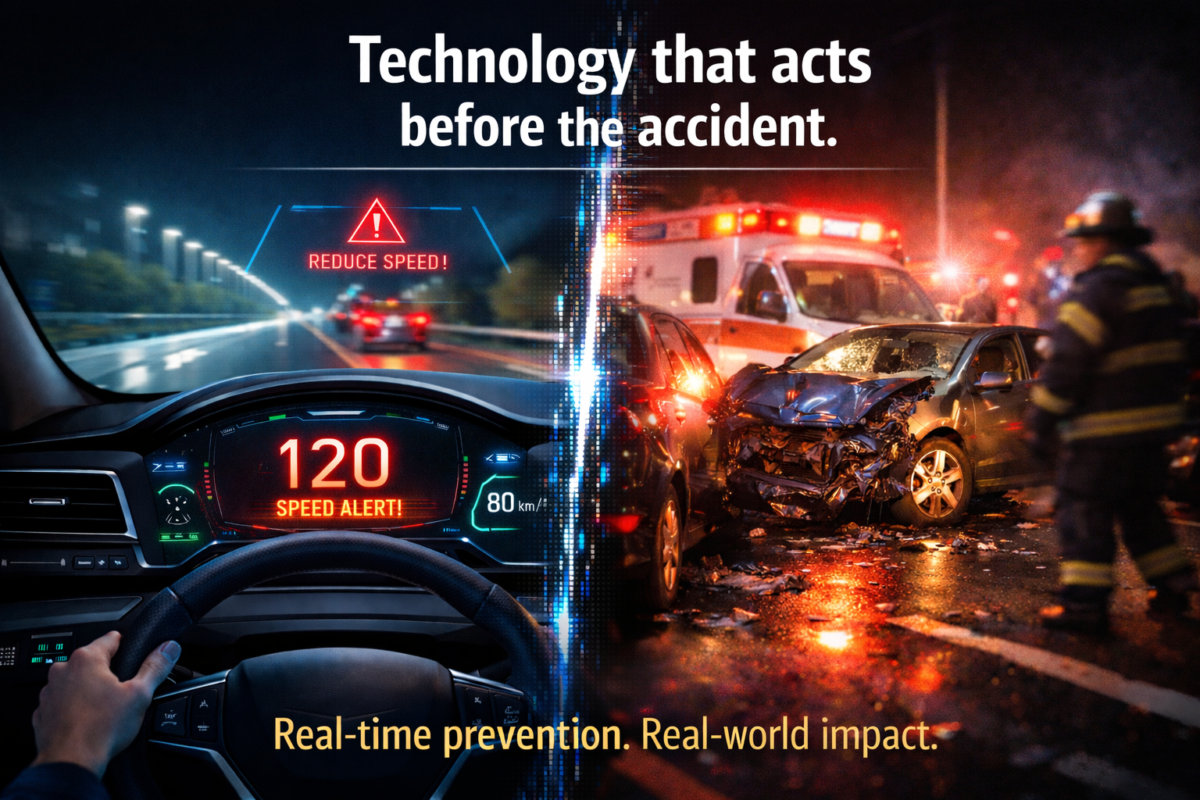
.
Policy-Relevant Vehicle Safety Innovation Introduces Real-Time Preventive Approach to Speed-Related Risk
A policy-oriented proposal with the potential to reshape how speed-related risk is managed across U.S. transportation systems
Olney, Maryland – April 2, 2026 – Every year, tens of thousands of lives are lost on U.S. roads due to a single, persistent factor: excessive speed—combined with the absence of continuous, real-time behavioral compliance mechanisms.
A new technological proposal, currently under U.S. provisional patent protection, has been introduced by Samuel Sales Saraiva, an independent inventor based in Maryland, presenting a structured and preventive approach to this challenge.
The system—titled Integrated Vehicular Speed Compliance, Preventive Alert, and Conditional Access Recording System (DSCPAS)—is designed to operate as a real-time safety layer within existing mobility frameworks. It promotes safer driving behavior through continuous monitoring, adaptive alerts, and structured data logic.
Statistical and Economic Urgency
According to the National Highway Traffic Safety Administration (NHTSA), the United States records approximately 40,000 to 43,000 traffic fatalities annually, with speeding contributing to nearly 29% of these deaths—representing more than 12,000 lives lost each year due to excessive speed alone.
Beyond the human toll, the economic burden is equally staggering.
- Total societal costs exceed $340 billion annually
- When including quality-of-life impacts, estimates surpass $1 trillion
- Auto insurance claims exceed $180 billion per year
- Property damage alone represents tens of billions annually
A significant portion of these losses is directly linked to speed-related incidents—ranging from material damage to severe injury and fatality compensation.
Critically, current enforcement frameworks—largely dependent on localized radar systems and intermittent policing—leave substantial gaps:
- Limited spatial coverage
- Reactive intervention models
- Billions in unrealized public revenue
- Persistent exposure to preventable risk
These figures reveal not only a public safety crisis, but a systemic inefficiency across regulatory, economic, and insurance domains.
A Preventive, Real-Time System
In this context, the proposed system introduces a structured mechanism designed not merely to observe behavior—but to influence it in real time.
Developed by Samuel Sales, the DSCPAS system integrates:
- Real-time speed monitoring based on roadway limits
- Immediate driver feedback and adaptive alerting
- Conditional data recording tied to compliance thresholds
- Structured access logic for insurers, regulators, and authorized stakeholders
Unlike traditional enforcement tools—which are inherently reactive—the system operates continuously, enabling behavioral correction at the exact moment risk emerges.
Policy and Market Relevance
At a time when the technological capability to prevent these losses already exists, the persistence of current fatality and cost levels is no longer a matter of limitation—
it is a matter of implementation.
The system presents cross-sector applicability:
- Public Safety Agencies – enhanced preventive enforcement
- Insurance Sector – improved risk modeling and loss reduction
- Regulatory Bodies – structured compliance frameworks
- Automotive Industry – integration into next-generation safety systems
Submission and Institutional Engagement
This proposal, authored and submitted by Samuel Sales Saraiva, has been formally presented to relevant public authorities and institutional stakeholders as part of a broader policy-oriented initiative.
Its objective is to contribute to ongoing discussions surrounding transportation safety, regulatory modernization, and scalable risk mitigation strategies.
Availability and Next Steps
The technology is currently protected under a U.S. provisional patent filing (U.S. Provisional Application No. 63/993,431, filed February 28, 2026) and is available for:
- Strategic partnerships
- Licensing opportunities
- Institutional evaluation and dialogue
Final Consideration
When preventable loss persists at this scale, the question is no longer whether solutions exist—
but whether systems are willing to evolve to implement them.
____
Comments:
Ricardo Menezes — Transportation Engineer
As a professional in the field of urban mobility, I view this proposal with great interest. One of the main limitations of current systems is that they are largely reactive — they act only after a violation or an accident has already occurred.
The idea of a system capable of continuous monitoring and real-time driver guidance represents an important paradigm shift: moving from a punitive model to a preventive one.
Additionally, the potential for structured data generation could benefit not only insurers, but also public planning, identification of high-risk areas, and the development of more effective policies.
If implemented with proper safeguards for privacy and governance, I see real potential for systemic impact in reducing risks and costs associated with traffic.
________
Juliana Carvalho — Mother and Citizen
I’m not an expert, but as a mother and a driver, this kind of technology brings me a sense of relief. Knowing that there could be a system that alerts drivers in real time — before a poor decision turns into a tragedy — changes how we think about road safety.
Most accidents don’t happen because of lack of knowledge, but due to distraction, haste, or overconfidence. A tool that “accompanies” the driver and helps correct those moments could save lives — including those of people outside the vehicle.
I truly hope initiatives like this move forward. Technology already does so much for us — it seems only fair that it should also help protect what matters most: human life.
________
Eduardo Nogueira — Public Policy Analyst
When we look at the annual number of traffic fatalities, it is difficult not to draw a deeper reflection: in many cases, the scale of human loss rivals — or even surpasses — the number of innocent lives lost in certain contemporary armed conflicts. The difference is that, here, these deaths occur silently, fragmented over time, and are often preventable.
This reveals an important contradiction: we live in an era of advanced technological capability, yet we continue to accept high levels of everyday risk on our roads. Technologies that act preventively, guiding drivers in real time, should not be seen as intrusive, but as instruments of collective protection.
At the same time, it is reasonable that there be tangible consequences for deliberately reckless behavior. A system that combines preventive guidance with mechanisms that create financial consequences for those who choose to violate the rules — especially when no visible enforcement is present — could contribute to a safer and fairer environment.
Driving is not an absolute right; it is a privilege conditioned upon responsibility. When a vehicle is operated negligently, it ceases to be merely a means of transportation and becomes a real risk to others.
If we have the technology to reduce this risk, the question is no longer technical — it is ethical: why are we not using it in a structured way?
_______