
.
Diplomatic Reciprocity between Brazil and the United States
.
Author: Samuel Sales (Saraiva)
Location: Washington DC – United States
Date: March 16, 2026
.
Cc:
President Donald J. Trump
Secretary Marco Rubio – United States Department of State
U.S. Embassy in Brazil
Additional Cc:
Bureau of Western Hemisphere Affairs – U.S. Department of State
U.S. Senate Committee on Foreign Relations
U.S. House Committee on Foreign Affairs
Subject: Brazil — Diplomatic Reciprocity or Political Convenience?
To the Government of the United States,
Recent events involving the decision of the Brazilian government to deny entry into its territory to President Donald Trump’s advisor, Mr. Darren Beattie, under the justification of the diplomatic principle of “reciprocity,” raise a reflection that goes beyond the episode itself and reaches a broader question: the coherence with which this principle has been invoked in contemporary political and diplomatic discourse.
If reciprocity is to constitute a legitimate foundation of relations between sovereign states, it must be applied with consistency, rationality, and intellectual honesty — not selectively, circumstantially, or according to momentary political convenience.
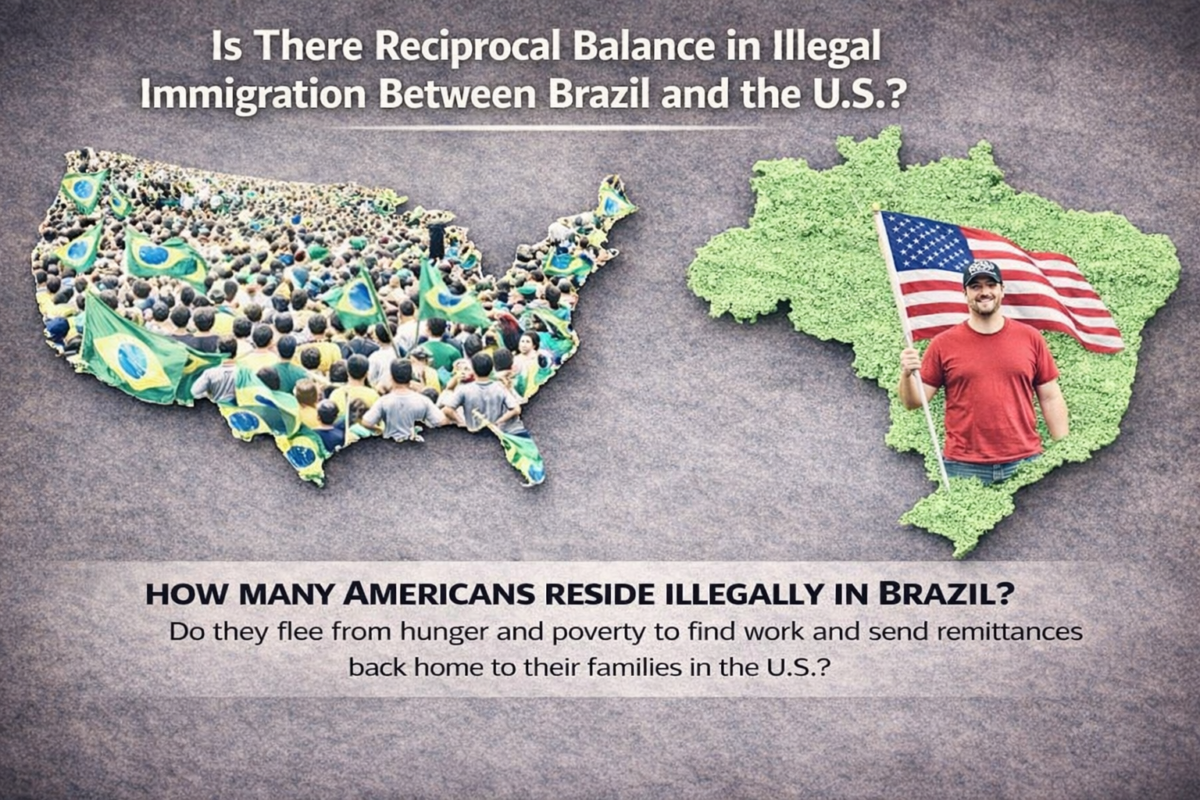
Brazilian President Luiz Inácio Lula da Silva chose to invoke this principle in defense of a political ally and foreign advisor. Yet this same concern does not appear to extend to the more than one million Brazilian citizens currently living in the United States under irregular immigration status.
Despite their vulnerable legal condition, these individuals work, produce, and send billions of dollars in remittances to Brazil each year — resources that sustain families and contribute significantly to the Brazilian economy. Many live under the weight of uncertainty and in the shadows of fear, while the Brazilian political establishment rarely demonstrates concrete concern for their reality.
This raises an unavoidable question:
Why is the principle of reciprocity readily invoked to protect authorities, advisors, and political interests, yet rarely remembered when it comes to recognizing or defending millions of ordinary citizens living abroad under difficult circumstances?
Diplomatic principles lose legitimacy when they are applied selectively.
Taken to its extreme, the argument of reciprocity could lead to absurd hypotheses — such as imagining the encouragement of an equivalent irregular migration of American citizens to the Amazon region. Such scenarios merely reveal how fragile this principle becomes when used as a rhetorical instrument in political disputes, rather than as a genuine foundation of diplomatic practice.
For this reason, the principle of reciprocity should not be reduced to a political slogan, invoked during moments of diplomatic tension by authorities claiming to act in the name of national sovereignty. Instead, it should reflect a genuine commitment to respect for the law, justice, and the dignity of citizens — not only those who occupy positions of power.
As a nation historically founded upon the rule of law, the United States possesses both the moral authority and the strategic responsibility to address such inconsistencies with clarity, balance, and firmness.
In an increasingly interdependent world, the coherence between proclaimed principles and actual practices has become one of the fundamental pillars of international credibility.
When principles are invoked only to protect allies or circumstantial interests, they cease to be principles — they become instruments of political convenience.
And when that happens, it is not only diplomacy that is weakened.
It is the very idea of justice in relations between nations that begins, quietly, to erode.
With due respect, President Lula: Would there be room for a reciprocal dialogue with President Trump regarding the situation of more than one million Brazilian undocumented immigrants currently residing in the United States?
Regards,
Samuel Sales
Observer of Brazilian political culture and Brazil–United States relations
Note: This message was posted on the official website of the White House as a public submission.
_________
Comment
Having observed, studied, and engaged with diplomatic reasoning across different institutional settings, I read this article with a rare — and revealing — combination of intellectual admiration and critical unease.
Admiration — because it restores a principle that should never have been diluted: coherence in the application of diplomatic concepts.
Unease — because the inconsistency it exposes is no longer episodic, but increasingly structural in contemporary foreign policy thinking, particularly among younger generations, often shaped more by ideological enthusiasm than by strategic discipline.
Reciprocity is not — and cannot be — a rhetorical ornament, to be invoked at the convenience of political circumstance. It is a structural principle. And like any principle of that nature, its legitimacy lies not in discourse, but in the consistency of its application.
To invoke it selectively, in isolated diplomatic episodes, while neglecting its implications in far more complex and consequential domains — such as migration, economic flows, and bilateral asymmetries — does not reflect analytical sophistication. It reveals, rather, a conceptual fragility carefully disguised as diplomatic virtue.
And it is precisely at this point that human reality — so often absent from diplomatic abstractions — imposes an uncomfortable contrast:
How do more than one million Brazilians living in the United States under irregular status perceive these minor diplomatic quarrels — these “picayune” disputes — unfolding at the level of high politics?
For them, reciprocity is not an academic concept, nor a rhetorical instrument. It is a potentially tangible reality, with direct consequences for their lives, their families, and their dignity.
From a distance, they observe debates conducted at elevated levels of policy formulation — often marked by symbolic gestures of limited practical relevance — while they themselves remain, in their daily lives, exposed to uncertainty, vulnerability, and, not infrequently, to the rigidity or even antipathy of U.S. government agencies.
In this context, the selective application of principles does more than weaken diplomatic coherence — it widens the gap between institutional discourse and the lived reality of those most affected by its consequences.
Such selectivity suggests something deeper — and perhaps more troubling: a growing confusion between moral signaling and strategic reasoning.
When diplomacy becomes a stage, and external action begins to respond more to domestic ideological expectations than to the demands of international reality, what is lost is the very attribute that sustains any position over time: credibility.
And without credibility, even the most well-intentioned causes become strategically irrelevant.
For those currently being trained in prestigious institutions — including Brazil’s diplomatic academy — this should serve as a moment of reflection that can no longer be postponed:
Are we cultivating diplomats capable of interpreting and confronting reality as it is — complex, asymmetrical, and often uncomfortable —
or are we, quietly, producing sophisticated interpreters of pre-existing narratives?
Because in international relations, reality does not bend to ideology.
It ignores it.
And principles, when applied selectively, cease to be principles — they become instruments.
— Jonathan A. Whitaker
_________
The text presented by the author addresses a sensitive issue that is rarely discussed with clarity in the public debate: the coherence with which the principle of reciprocity is invoked in international relations.
In the theory of diplomatic relations, reciprocity constitutes one of the classic pillars governing the coexistence of sovereign states. However, as the article rightly suggests, this principle is often no longer applied as a universal rule and instead becomes selectively invoked according to the political conveniences of the moment.
The author’s reflection carries particular merit because it emerges from an uncommon perspective: that of someone familiar with the social, cultural, and political realities of both Brazil and the United States. This dual experience allows certain contradictions to be perceived—contradictions that frequently remain unnoticed within the domestic debate of each country.
By raising the question of migratory asymmetry between the two nations, the text does not seek to reduce a complex phenomenon to a simple diplomatic equation. On the contrary, it invites the reader to reflect on something deeper: the recurring tendency of governments to invoke legal or diplomatic principles only when they serve specific and circumstantial interests.
Ultimately, the argument presented is not a criticism directed at any single country, but rather an observation about a persistent challenge in international politics: when principles cease to function as principles and become merely rhetorical instruments.
This reflection alone fulfills an important role in the public debate, reminding us that the credibility of any government in the international arena depends, above all, on the coherence between what it proclaims as principle and what it practices as policy.
— Dr. Adrian Whitmore
Professor of International Relations
Former Lecturer at the Diplomatic Training Institute
Having observed diplomatic practice across different institutional contexts over the years, one learns that the strength of a principle lies not in its invocation, but in its consistency.
The recent episode involving the denial of entry to a U.S. official under the justification of “reciprocity” raises a question that goes beyond the immediate case. Reciprocity, if it is to be taken seriously, must withstand application across multiple domains — not only in isolated political gestures, but also in more complex and consequential realities, such as migration flows, economic asymmetries, and long-term bilateral dynamics.
Selective application may serve short-term narratives, but it rarely survives broader strategic scrutiny.
From a distance, the situation appears less as a matter of doctrine and more as a matter of positioning.
Brazil spoke as if it were operating within a framework of symmetry.
The United States, however, interpreted it with the awareness that such symmetry is, at best, limited.
This is not necessarily a crisis. It is, however, a revealing moment.
Because in diplomacy, inconsistencies are seldom confronted immediately —
they are remembered, catalogued, and, when convenient, revisited.
And that, more than any immediate reaction, is where the true weight of such decisions tends to reside.
— Charles E. Harrington
Former Diplomatic Observer