
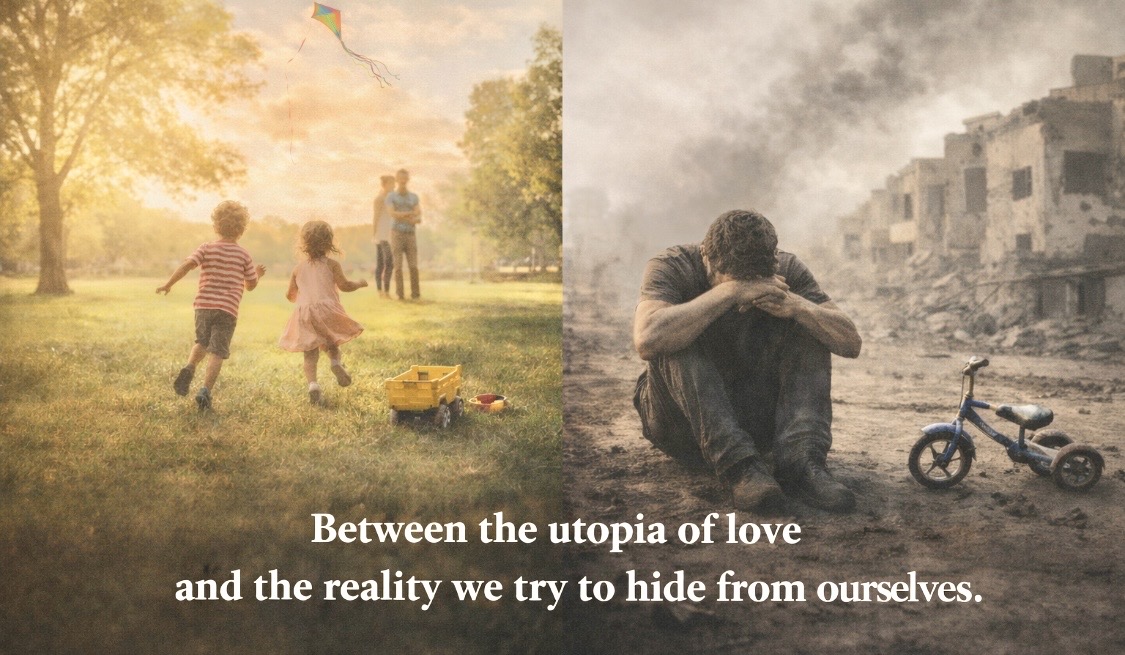
.
A reflection on human consciousness, its distortions, and the inability to live what we most proclaim
There is within the human heart a rare jewel — silent, ancient, and present since the very first breath of existence.
We call it love.
Everyone recognizes it.
Few truly understand it.
Almost no one fully lives it.
We admire love as an idea, yet fail to embody it in practice.
What should liberate becomes possession.
What should be giving turns into demand.
What is meant to unite becomes control.
And in trying to hold it, we suffocate it.
We build invisible fences.
We create emotional contracts.
We mistake fear for care.
We confuse love with control — and in doing so, we lose both.
True love does not imprison.
It does not demand submission.
It cannot survive force or ego.
It requires courage.
The courage to accept a simple yet revolutionary truth: one’s rights end where another’s begin.
Without this, there is no love — only intrusion.
Without this, there is no connection — only domination.
To love is to recognize limits.
To understand that the other does not belong to us.
To respect their existence as whole, independent, and inviolable.
Love is untamable — it does not bow to force, nor does it grow under imposition.
And more:
Love is not conditioned by the charms or the temporary comforts of materiality.
What depends on possession, exchange, or return is not love — it is convenience.
And when forced,
love ceases to be essence — and becomes oppression.
Every attempt to dominate it is, in truth, its denial.
Yet we persist.
And in trying to control love, humanity reveals not strength, but the limits of its own consciousness.
And perhaps one of the deepest distortions of all:
we reduce love to mere carnal impulse.
We interpret it as a purely sexual act,
as momentary satisfaction,
turning one another into vessels of organic desire.
We confuse instinct with essence, desire with the soul.
But there is another distortion — more subtle, yet equally dangerous.
Throughout history, love has often been appropriated by structures of power,
invoked as discourse,
instrumentalized as promise.
In the name of “higher purposes,” love is proclaimed — yet division is practiced.
Institutions that should elevate the human spirit
sometimes condition it, limit it, and manipulate it.
They speak of transcendence,
yet remain bound to material interests.
They speak of unity,
yet sustain separation.
And in contradictions that span centuries,
human beings continue to harm, judge, and even kill one another, believing they possess the truth about love.
As if the right to life could be defined by beliefs,
by identity,
by social or economic condition.
Such notions do not withstand reason — and even less, humanity.
This distortion does not remain confined to human relationships.
It expands.
It manifests in violence, exploitation, and indifference to suffering.
It reaches not only people, but also those who have never betrayed love:
animals.
Beings who offer presence without demand, loyalty without contract, affection without calculation.
They love in ways humanity has forgotten.
On the difficult path toward the evolution of mind and spirit, we remain far from understanding.
Gradually, we drift away from our own essence.
And along this path, we carry marks.
Actions that reflect the absence of love — not always intentional,
but undeniably real.
Not all expressions of unlove are born of malice — many arise from a lack of awareness.
We wound because we were wounded.
We repeat because we were shaped.
And then, too late, we understand.
Time — unforgiving — does not allow repair.
We fail to offer what we expect to receive — not by conscious choice, but by incapacity.
Emotional.
Intellectual.
Existential.
And so we continue.
Generations replace generations.
Civilizations repeat the same patterns.
True love becomes a distant idea — almost an illusion.
A silent abstraction, proclaimed by many, lived by few.
And reality reveals this contradiction.
It suffocates.
It wounds.
It exposes.
Perhaps, then, the greatest challenge of humanity is not to find love.
But to become capable of understanding it.
And beyond that:
to become worthy of living it.
Reflections
Perhaps love is not absent from the world.
Perhaps it is merely buried beneath layers of conditioning, fear, and unconsciousness.
And perhaps rediscovering it does not require seeking it outward,
but removing, within us, everything that was never love.
If there is hope, it does not reside in structures, nor in discourse, nor in promises repeated across time.
It resides in the silent moment when a human being awakens…
and chooses, at last,
not to repeat what once wounded them.