
.
Natural laws cannot be overridden by human insanity.
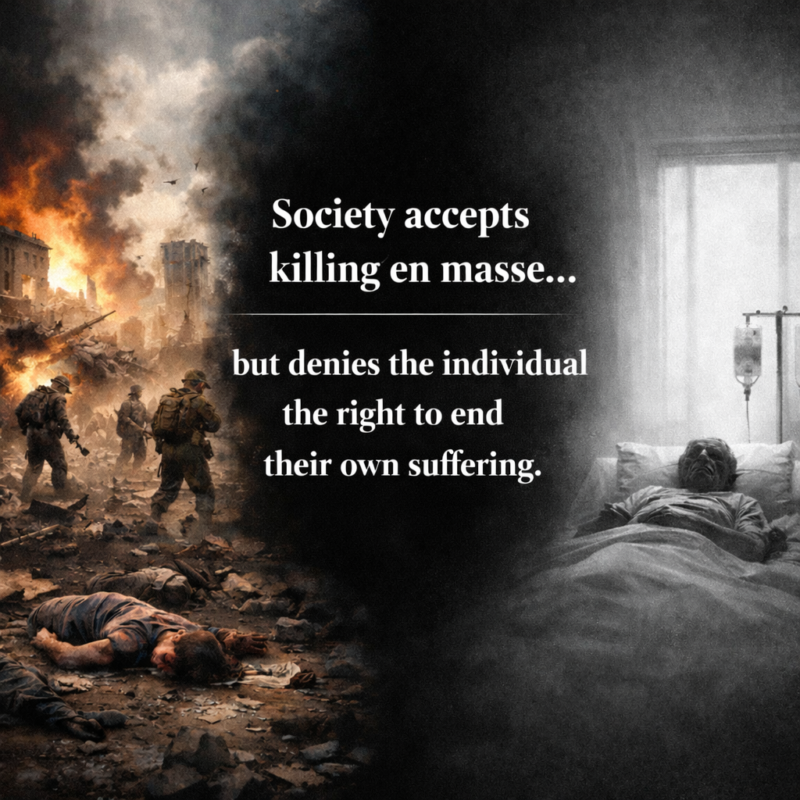
Societies resolve their conflicts through wars, killing even innocent civilians, which reveals the absence of moral legitimacy to prohibit euthanasia and condemn terminally ill patients to unjustifiable and inhumane suffering.
No human law can stand above natural rights. Therefore, prohibiting euthanasia, beyond disrespecting this right, constitutes a hypocritical, unjust act, lacking moral and rational legitimacy.
Invoking the right to kill in the name of a God said to be love is, at the very least, paradoxical. Even more so: it is inconsistent to impose laws in His name to justify the cruel, inhumane, and indecent imposition on those who plead to relinquish a reality that no longer represents living — but merely existing, condemned to pain.
Chronic ignorance, religious fanaticism, and the distortion of reason through narratives based exclusively on faith constitute an aggression against the moral and ethical principles that should guide a civilized consciousness.
Faith, as an individual expression, is a right. But it cannot serve as legal or moral grounds to override another’s natural rights — under penalty of losing practical validity and rational legitimacy.
“Free will ends at the boundary of another’s rights.”
And here lies an unavoidable question: if we do not deny animals the right to assisted death — supported by objective and compassionate criteria — why do we deny it to human beings?
Foundations already accepted — when it comes to animals
Moral
- Avoidance of extreme and irreversible suffering
- Principle of compassion above prolonging pain
- Ethical responsibility to protect well-being
Humanitarian
- Guarantee of a painless death (controlled and humane procedure)
- Indicated in cases of terminal illness or untreatable pain
- Recognized by entities such as the American Veterinary Medical Association as an ethical practice when justified
Mental / Psychological
- Reduction of emotional suffering by avoiding witnessing ongoing pain
- A more conscious and compassionate grieving process
- Decisions based on care, not neglect
Spiritual
- An act of mercy and liberation from suffering
- Respect for the natural cycle of life when recovery is no longer possible
- Understanding detachment as a form of love
Professional / Technical
- Evaluation and recommendation by a veterinarian
- Safe sedation and induction protocols
- Decisions guided by well-being as the primary priority
So why deny this to humans?
Beings who, in addition to free will, feel pain, suffer, understand their condition, and perceive the total loss of quality of life?
Why condemn them to prolonged suffering — shared even by those who, out of love, compassion, or gratitude, accompany the dying toward an uncertain end?
Free will: a widely recognized concept
Free will is the capacity for autonomous choice exercised through human will.
It is the right to decide based on values, beliefs, consciousness, and perception of reality.
This concept is directly linked to the right of choice.
The actions resulting from this choice belong to the individual and their conscious will.
Historically, free will holds a central place in philosophy, science, and religion, with deep moral, psychological, and social implications.
Yet, precisely at the moment when its application becomes most relevant — in the face of irreversible suffering — it is denied.
Moral responsibility and scientific perspective
Moral responsibility presupposes continuity of human identity throughout life, regardless of physical and mental transformations.
Science, at various times, has approached the universe through a deterministic lens, raising doubts about the very existence of free will.
Even so, despite philosophical questioning, the human experience of choice remains the foundation of individual decisions.
The religious paradox
According to many religious traditions, free will is a gift granted by God — the ability to choose between good and evil.
But this idea raises unavoidable questions:
If free will was granted, why limit its application?
If God is omniscient, did He foresee the consequences?
If He created everything, including evil, where does responsibility lie — with creation or the creator?
If, hypothetically, the creator foresaw a world marked by suffering, violence, destruction, and moral contradictions, an inevitable question arises:
Where does ultimate responsibility reside?
In the suffering individual?
Or in the system that conditions him?
The moral incoherence of prohibition
Prohibiting euthanasia ultimately reveals itself as a form of institutionalized cruelty.
It is the suppression of free will.
It is the condemnation of an innocent person to avoidable suffering.
It is the imposition of pain under justifications that do not withstand rational scrutiny.
If God is love, and suffering implies the absence of that love, why impose suffering on someone who, in full awareness, seeks to be free from it?
This contradicts logic, offends reason, and reveals an attachment to dogmas that coexist, paradoxically, with the benefits of science — the same science that prolongs life, but ironically cannot allow it to end with dignity.
Final reflection
Free will deprived of discernment — or prevented from being exercised — is like a high-performance car without brakes.
At some point, the consequence will inevitably be tragic.
If there is freedom, it must be accompanied by responsibility and awareness.
If there is irreversible suffering, there must at least be the right not to prolong it.
Denying this is not protection.
It is imposition.
Closing
They promote wars.
They accept — and often legitimize — mass death, including that of innocents.
Yet, paradoxically, they prevent the end of the suffering of someone who, in full awareness, simply wishes to be free from pain.
And still, they claim: “life belongs to God, and only He can take it” — a convenient, selective, and deeply distorted interpretation.
Because, in practice, life is taken every day by human beings themselves, in different contexts — wars, conflicts, violence — often without hesitation, without reflection, without compassion.
This contradiction is not merely inconsistency.
It reveals something deeper:
the same human nature that destroys itself in wars
is the one that, under fragile moral justifications, imposes suffering on the dying.
There is, in this, a disturbing convergence —
not of elevated values, but of the rawest expression of human inconsistency.
To deny someone the right to decide their own end, when no dignified life remains to be lived,
is not protection.
It is imposition.
It is the deliberate prolongation of pain.
And, ultimately, it is a silent form of cruelty —
inflicted upon someone who no longer even has the strength to defend themselves.