
.
The violence that haunts the world today is, to a great extent, the fruit of what societies have offered their own children. What is deposited in developing minds inevitably returns to society in the form of adults who often stumble through mental landscapes marked by banality and socio-cultural superficiality — frequently deprived of the critical sense necessary to escape the collective absurdity that emerges when consciousness is replaced by mere repetition.
Hatred, threats, desires for revenge, selfishness, chronic dishonesty, intolerance, fanaticism, and delirious lies imposed as truth — often legitimized by religious or ideological systems — become seeds planted in childhood.
Worse still, such ideas are eventually converted into patterns that come to govern the conduct of individuals, groups, peoples, and even nations, crystallizing the hypocrisy with which they judge and attack one another, sustaining entire systems driven by energies as backward as the very hell they claim to exist — recreating it here, in this world, in a pretentious and destructive insanity incomprehensible to those who have reached some degree of awareness or what we call the age of reason.
It is precisely during childhood — when the mind is still vulnerable and malleable — that many of these constructions are installed.
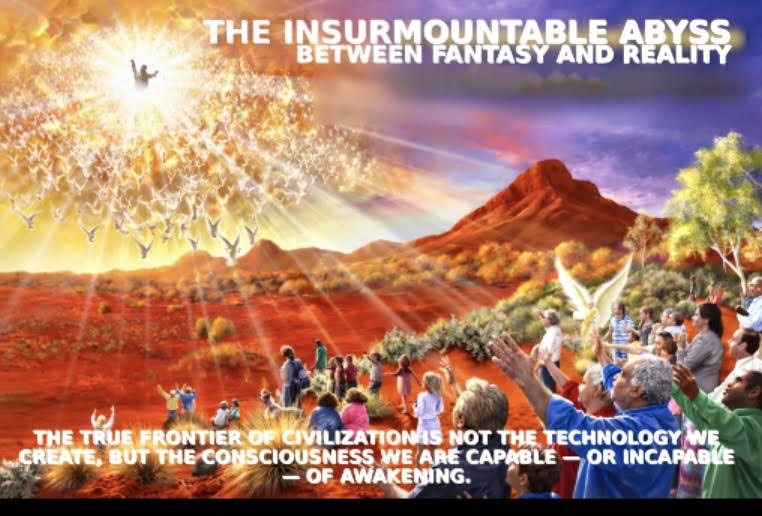
Children are told of heavens upon heavens, of eternal fires of hell and promised paradises, creating imaginary universes that shape thought before reason has even had the chance to blossom.
Thought is molded and governed through fear — a psychological terror frequently disguised as virtue, normalized and doctrinally presented under the appearance of dignity, ethics, and lucidity.
These seeds grow.
In adulthood, they return to society in the form of the same beliefs, the same hostilities, and the same collective delusions — reproducing, generation after generation, what was absorbed in the obscurity of minds that were rarely taught to open themselves to the light of reason.
Meanwhile, logic, inquiry, and critical thinking continue, in many places, to be systematically discouraged or even openly resisted.
The history of civilization shows that material progress is not necessarily accompanied by progress in consciousness. Technologies advance, cities expand, and economic systems become more sophisticated — yet the primitive impulses governing the human mind often remain almost unchanged.
Thus, societies capable of building extraordinary machines remain, at the same time, prisoners of ancestral fears and imaginary narratives that hinder collective intellectual maturity.
Identifying a small serpent crawling on the ground may offer the chance to prevent death when it grows — for its nature will be to kill, even without awareness of its own actions.
With human beings, unfortunately, something similar often occurs.
When societies nourish cycles of ignorance, fear, and superstition, they tend to reproduce these same patterns indefinitely. Even cultures that proclaim themselves advanced are not immune to this phenomenon.
Statistics, recurring conflicts, and reality itself frequently discourage hope for an easy civilizational leap for humanity.
Yet understanding the origin of these seeds may be the first step toward breaking the cycle.
For civilization is not measured by the brightness of its cities, but by the level of consciousness within its minds.
And as long as we continue to educate children to fear, to hate, or to believe without questioning, we will merely perfect the tools of progress while perpetuating the shadows of barbarism.
_____________
Comment:
Dear Samuel, the text reveals a rare argumentative coherence and depth of reflection, guiding the reader toward an uncomfortable — yet necessary — contemplation of the structural roots underlying many of the contemporary challenges of civilization.
Perhaps one of the greatest mistakes societies make is to assume that their problems arise merely from circumstantial factors — political crises, economic disputes, or conflicts between nations.
In reality, processes of civilizational regression tend to originate at a much deeper and more structural level, germinating silently in the most delicate and decisive territory of all: the minds of children.
It is there that the possible horizons of humanity are defined.
If fear, dogma, and intellectual submission are cultivated within them, the future will tend to reproduce the same shadows that history has witnessed so many times before. If, on the contrary, free thought, honest curiosity, and the courage to question are allowed to flourish, the possibility of a more lucid civilization begins to emerge.
In the end, the collective destiny of humanity may depend less on the technologies we develop or the wealth we accumulate — and far more on what we choose to allow to inhabit the spirit of new generations.
For a society may survive material poverty for some time, but it rarely survives for long the poverty of consciousness.
– Joe Clark
_______
Excellent text, Sam. It profoundly reveals a lucid and distinguished way of thinking. It presents a consistent reflection on the role of education and ideas in the formation of societies. It shows that the true progress of a civilization does not depend solely on technological advances, but above all on the quality of the ideas transmitted to new generations.
At the same time, the text invites the reader to reflect on the importance of cultivating reason, discernment, and freedom of thought in children, suggesting that social transformation begins precisely in the way we educate and shape human consciousness.
— Isarina Pinheiro