
.
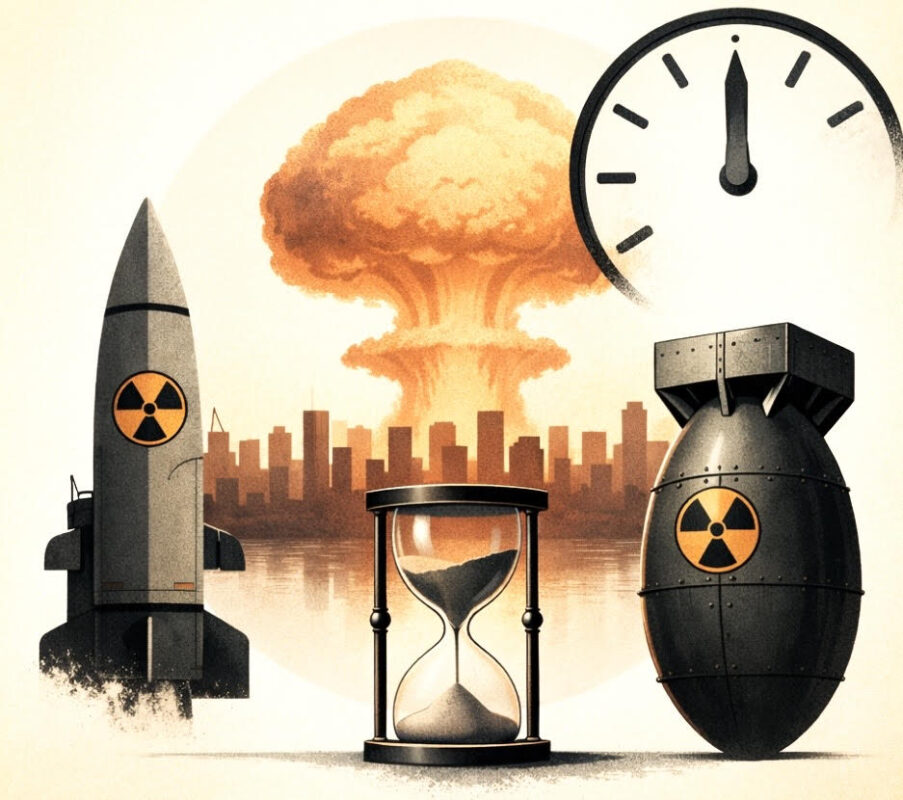
Low-yield warheads, strategic deterrence, and the enduring dilemma of technological power in an ethically fragile world
“Life does not ask the mind for permission to have meaning — it imposes it.”
.
In recent years, the debate over the development of lower-yield nuclear warheads has returned to the center of international strategic discussions. Within military circles, these systems are commonly known as low-yield nuclear weapons.
In some public narratives, however, the subject has been simplified and described as the development of “micro nuclear bombs.”
The reality, however, is more complex.
What is under discussion is not exactly a new category of weapon, but rather lower-yield versions of nuclear warheads that already exist, designed within the traditional logic of nuclear deterrence.
Even so, their existence raises profound questions — not only strategic, but ethical, political, and civilizational.
What Is Actually Being Developed
In 2018, the United States Nuclear Posture Review proposed the development of a lower-yield nuclear warhead for certain submarine-launched ballistic missiles.
This system became known as the W76-2.
Its estimated yield ranges between 5 and 7 kilotons, significantly lower than many modern strategic nuclear warheads and also smaller than the bomb dropped on Hiroshima in 1945, which had an estimated yield of around 15 kilotons.
Still, one essential point must be emphasized:
This remains a real nuclear weapon with enormous destructive capacity.
The Strategic Logic Behind the Proposal
The reasoning presented by military strategists is grounded in the long-standing doctrine of nuclear deterrence.
According to this perspective, certain adversaries might assume that the use of low-yield tactical nuclear weapons would not provoke a proportional response. In this context, developing smaller warheads would provide additional limited-response options, thereby reinforcing the credibility of deterrence.
In other words, the intention is not to make nuclear use more likely, but rather to discourage it by closing perceived gaps in deterrence.
This logic, although controversial, has shaped nuclear strategy since the early years of the Cold War.
Criticism and Strategic Concerns
However, many international security experts have raised significant concerns.
One of the central criticisms is that lower-yield nuclear weapons may lower the psychological threshold for nuclear use, making escalation more conceivable.
Another concern frequently raised is that in a real conflict scenario there is no reliable way for an adversary to determine whether a missile carries a low-yield or high-yield nuclear warhead.
This ambiguity could trigger immediate and potentially catastrophic retaliation.
In other words, even a supposedly “limited” nuclear use could unleash unpredictable strategic consequences.
The Enduring Paradox of the Nuclear Age
Since 1945, humanity has lived under a singular paradox:
the attempt to preserve peace through the existence of weapons capable of destroying entire cities.
Lower-yield nuclear weapons do not resolve this paradox — if anything, they may highlight it even further.
Regardless of their relative yield, any nuclear weapon remains a weapon of mass destruction, whose humanitarian, environmental, and political consequences would be devastating.
A Civilizational Reflection
The debate surrounding lower-yield nuclear weapons ultimately reveals something deeper than a purely technical dispute.
It exposes a persistent dilemma of modern civilization:
the search for security through instruments that, if used, could compromise the very future of humanity.
History suggests that the real challenge is not simply the development of technology, but the cultivation of wisdom sufficient to live responsibly with the power it places in human hands.
While genuine threats hang over the continuity of human existence, large segments of society remain distracted between surreal promises of imagined paradises and the entertainment of trivial distractions — often reduced to idle gossip and superficial noise that contributes nothing to the collective destiny or to the advancement of reason.
This asymmetry between technological power and moral maturity may well represent one of the greatest risks of our time.
Increasingly sophisticated technologies may eventually fall into the hands of authoritarian regimes, terrorist organizations, or fanatical groups that view destruction as a political or religious instrument.
Faced with such possibilities, concern among international analysts and strategists about the limits of global security has grown. In some geopolitical circles, these concerns have even strengthened debate around the theory of preventive action as a mechanism for containing emerging threats.
The central dilemma of our era may not simply be what humanity is capable of creating, but whether it will possess the wisdom necessary to prevent that power from being turned against itself.
Ultimately, the greatest danger of our time may not be the threats that surround us — but the unsettling absence of awareness in the face of them.
Commentary
Humanity lives with a troubling paradox.
Never before has technological progress advanced at such speed, and never before have we had access to such extraordinary capabilities — from artificial intelligence and biotechnology to global-range military systems.
Yet the ethical, political, and civilizational maturity that should accompany this power has not progressed at the same pace.
The result is a world in which tools capable of transforming human life for the better also carry an unprecedented destructive potential.
— Kevin Delani