
.
Between comfortable ignorance and the courage to think beyond — breaking away from the single-lens mindset as a subtle, habitual, and often unnoticed pattern
There is a silent — and dangerously widespread — tendency to interpret reality from a narrow, limited angle, almost always conditioned by previously absorbed beliefs and rarely questioned assumptions.
The single-lens mindset is not the exception — it is a common pattern, often imperceptible, that restricts the mind without it even realizing it.
This is not a matter of lack of intelligence.
It is, above all, a lack of willingness to see beyond.
Most people do not seek to understand reality in its complexity.
They seek only to confirm what they already believe.
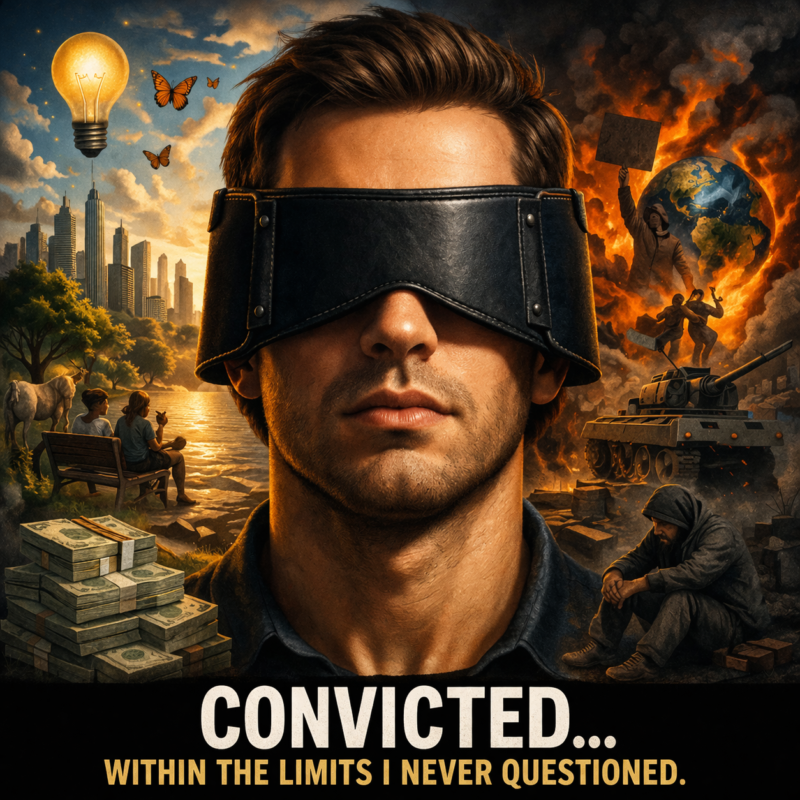
They live within a kind of “mental blinder” — a reduced field of vision carefully shaped by social, cultural, and ideological influences, which defines not only what is seen… but also what is accepted as truth.
And perhaps most unsettling of all:
Few even ask whether other perspectives of reality might exist.
The Comfort of Belief
There is a certain comfort in remaining within the limits of what is already known.
Questioning requires effort. It demands deconstruction. It requires courage.
And not everyone is willing to pay that price.
Breaking away from deeply rooted beliefs is not merely an intellectual exercise — it is often a painful process.
It implies recognizing that what one has defended with conviction… may be incomplete, distorted — or simply wrong.
That is why many choose to remain within the comfort of their own limitations.
The Illusion of Conviction
Conviction is not synonymous with clarity.
More often than not, it is simply the reflection of a belief that has never been questioned.
The confidence with which someone holds an idea does not validate its truth.
It merely reveals the depth of their attachment to it.
And this is where limitation becomes most dangerous: when it begins to masquerade as truth.
Invisible Servitude
There is something even more unsettling than limitation itself:
the passive willingness to serve it.
Many do not merely fail to see —
they do not wish to see.
They become useful instruments of external narratives, replicators of ideas they do not fully understand, defenders of interests they do not even recognize.
They move with conviction… but without awareness.
And in doing so, they surrender not only their discernment —
but also their freedom to think — to opportunists who may not even know they exist, yet still use them with silent and calculated precision.
Final Reflection
Our perception of reality is not neutral — it is constructed by the brain based on beliefs, experiences, and, not infrequently, impulsive deductions disguised as reason.
And without conscious awareness, many end up defending — with conviction — their own limitations.
“Our perception of reality is not neutral — it is constructed by the mind through beliefs, experiences, and, not rarely, impulsive conclusions disguised as reason. And without conscious awareness, many end up defending — with conviction — the very limits that imprison their own understanding.”
Comments
—Victor Hale (Literary Comment)
The Illusion of Seeing Through a Narrow Lens, by Samuel Saraiva, is more than an essay on perception — it is a precise dissection of one of the most persistent traits of the human condition: the tendency to mistake conviction for understanding.
From its opening lines, the text establishes with striking clarity that perception is not neutral. It is shaped by beliefs, experiences, and, not infrequently, by impulsive deductions disguised as reason. From this premise, the author expands the argument beyond any specific political or cultural setting, framing it within a universal human pattern — one in which cognitive bias, ideological bubbles, and perceptual limitations present themselves under the reassuring guise of certainty.
The essay unfolds with a compelling internal progression. It begins with the subjective construction of reality, moves into the psychological comfort of unchallenged beliefs, and then deepens into what may be its most unsettling insight: the voluntary servitude to one’s own limitations. It is not merely a failure to see — but a reluctance to do so.
Notably, the author avoids political reductionism. The critique is not aimed at a particular group, but at a recurring human behavior that transcends cultures, ideologies, and borders. This choice grants the text intellectual depth and lasting relevance, elevating it beyond the immediacy of partisan discourse.
Certain passages capture the essence of the argument with surgical precision. The assertion that most people do not seek to understand reality in its complexity, but merely to confirm what they already believe, reveals an uncomfortable truth stripped of embellishment. And in its closing, the essay delivers its most powerful insight: the most dangerous form of blindness is not the inability to see — but the certainty that one already does.
This is a text that does not simply invite reflection — it demands discomfort. And it is precisely in that discomfort that its greatest strength lies: confronting the reader with the possibility that their certainties may not be signs of clarity, but boundaries never questioned.
________
Originally published as a comment on the author’s WordPress blog and reproduced here from the original version.
— Auctor Anonymus