
.
The Extraordinary Beauty of the Blue Planet — and the Unsettling Responsibility to Exist and Care
There are images that do more than captivate — they disarm.
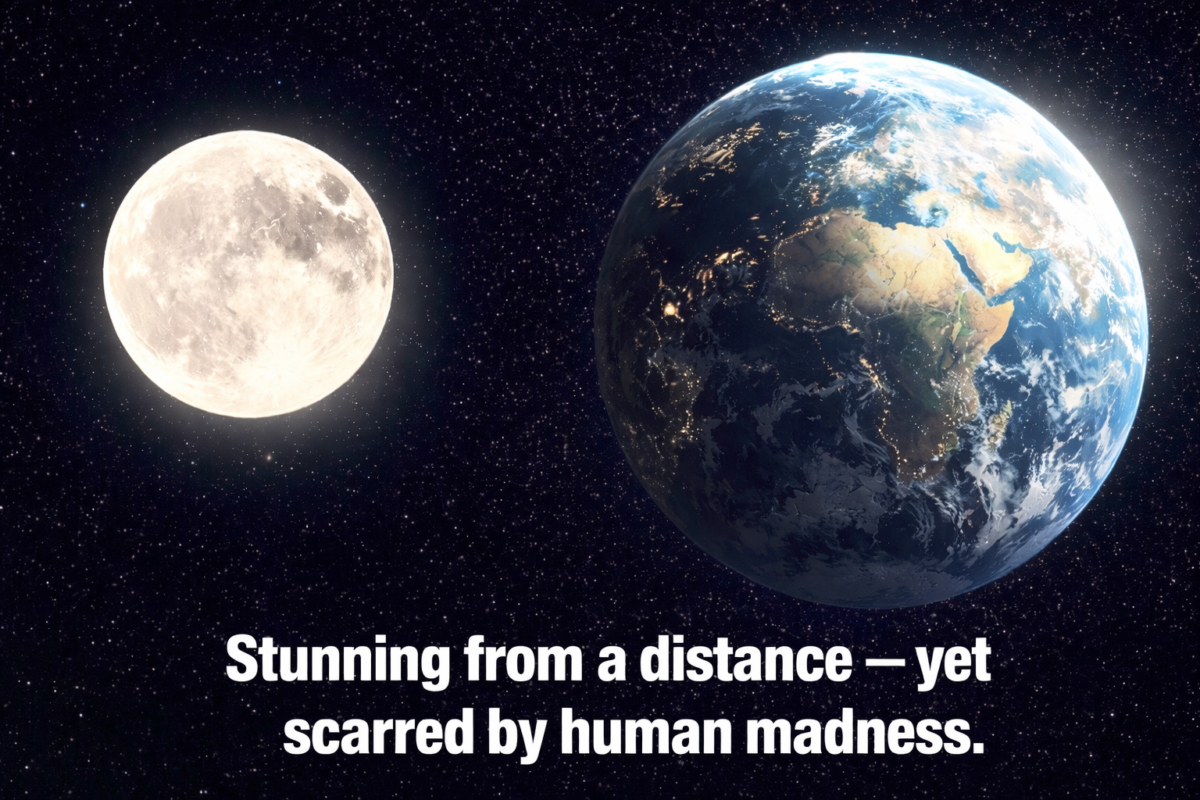
The Moon seen from Earth…
and Earth seen from the Moon.
Two perspectives of the same universe.
Two scales of the same existence.
And between them, a contrast that is not merely visual — it is moral.
For someone standing on the lunar surface, looking up at the sky, Earth would not appear as a delicate detail the way the Moon does to us.
It would be a dominant presence. Almost unavoidable.
Approximately 3.7 times larger in apparent diameter.
Nearly 14 times more area in the sky.
Brighter. More alive. More intense.
Not a pale disk — but a pulsating organism.
The deep blue of the oceans.
The dynamic white of moving clouds.
The contours of continents revealing ancient stories.
Storms swirling like visible breaths of a living system.
And there is something even more unsettling in this vision:
for someone standing on the Moon, Earth would appear almost motionless — suspended in the sky, constant, silent… while the entire universe moves behind it.
Like a beating heart… unnoticed.
The Beauty That Exposes Human Contradiction
If the Moon, seen from here, already inspires poetry, contemplation, and silence…
then Earth seen from there would feel something close to sacred.
And that is precisely where the unease begins.
How can a world that, from afar, reveals itself as a living jewel suspended in the void…
be harmed by those who inhabit it?
How can such cosmic harmony coexist with such human disorder?
There is, within the human condition, an almost unsettling contradiction:
we are capable of contemplating the sublime —
and yet neglecting it.
We recognize beauty —
but fail to protect it.
We speak of progress —
but often destroy what makes life possible.
Not out of pure ignorance…
but often out of something more dangerous:
comfortable, chronic, accommodated ignorance.
We Are Not Owners — We Are Guests with Limited Time
Earth does not belong to us.
It is not property.
It is shelter.
It is not a guaranteed inheritance.
It is a silent loan.
And perhaps it is necessary to remember — with the sobriety that truth demands:
We are not owners.
We are merely travelers — brief pilgrims —
and we will leave empty-handed.
We are passengers — and the sense of ownership is often a fragile illusion.
We are caretakers — not owners.
And yet, we act as if time were infinite,
as if resources were endless,
as if consequences could always be postponed.
But they cannot.
Every daily choice — invisible, small, seemingly irrelevant —
is, in truth, a stroke in the design of the future.
The True Sign of Intelligence
Perhaps we have misunderstood what it means to be intelligent.
It is not only about creating technology.
Not only about innovating.
Not only about conquering.
True intelligence may lie in something simpler —
and infinitely more difficult:
to preserve.
To preserve what we did not create.
To care for what we will not have time to rebuild.
To honor what was entrusted to us without instructions… and without guarantees.
Because destruction requires impulse.
But preservation requires consciousness.
A Silent Letter to the Future
Every generation writes a letter.
Not with words —
but with actions.
This letter will not be read in books.
It will be read in the condition of the world we leave behind.
In the air that can still be breathed.
In the water that can still be consumed.
In the life that can still flourish.
And in light of that, the question ceases to be philosophical —
and becomes inevitably moral:
Will we be remembered as those who merely consumed…
or as those who cared?
A Call to Awareness
Perhaps we should look at the sky more often.
Not only to admire —
but to remember.
To remember that that small blue dot, seen from afar,
is everything we have — temporarily.
And that its beauty is not a guaranteed spectacle —
it is a shared responsibility.
May we be less selfish.
Less blinded by convenience.
Less anesthetized by routine.
Less distracted by the superficial.
And a little more conscious.
Because, in the end,
it will not be the greatness of our achievements that defines who we were…
but the care we showed
for what never truly belonged to us.
✍️ COMMENT
John Patrese — Essayist
Your text does not merely describe — it reveals.
The comparison between the Moon seen from Earth and the Earth seen from the Moon goes far beyond aesthetics; it places us face to face with an uncomfortable truth. When we imagine our planet from the outside — not as a map, but as a living, breathing, fragile organism — something shifts within us.
Earth ceases to be scenery… and becomes responsibility.
Perhaps what is most unsettling is not the beauty itself, but the contrast between that visible perfection and the way we treat it. It does not feel like mere ignorance — at some level, it resembles a quiet form of ingratitude.
After all, this planet does not belong to us. It merely shelters us — for a brief interval of time.
And within that brevity lies a commitment we often forget:
not to interrupt what we did not create,
and to preserve what will one day sustain others.
Your text reminds us, with both sensitivity and strength, that existing here is not an absolute right — it is, above all, a loan.