
Suddenly awakened, reflecting on the ephemerality of human existence, I feel compelled to write — as one who refuses to waste the sparks of lucidity that emerge in the silence of the early morning hours.
Perhaps insomnia — that unwelcome guest that lingers when the body longs for rest — is, paradoxically, one of the few moments when consciousness finds enough quiet to hear itself, free from the practical urgencies of the day.
As time passes, whether in awe or distraction, we contemplate a universe whose beauty we can perceive only within the narrow limits of our own sight. Some seek to understand the true meaning of existence; others occupy themselves with conjectures they attempt to turn into reality; while multitudes find comfort in the unlikely belief that there are paths leading them to eternity — to reunions with those they once had the privilege of sharing life with, but not always the wisdom to cherish as they deserved.
All of us, without exception, have been granted the rare privilege of arriving in this dimension to experience something truly celestial — not in a mystical or divine sense, but in a cosmic one: the experience of inhabiting this celestial body we call the universe.
The mind fears because it longs for permanence.
Reality moves forward because it operates through transformation.
Between these two forces, anxiety is born: the desire for stability confronting the inevitable nature of change — the honest dialogue between the friction of desired permanence and unavoidable transformation, often imperceptible to minds overshadowed by fear, suffering in anticipation within the scarcity of inner light.
To acknowledge — with fear or in spite of it, whether we’re attached to this life or not — that every biological cycle comes to an end can open the door to a quiet kind of inner peace. To calmly accept that, at the end of this passage, nothing we now experience as material will persist in any recognizable form — and that we will become, at most, energy dispersed into the fabric of the cosmos — does not diminish the meaning of existence; on the contrary, it helps dissolve unsustainable expectations and frees us, in some measure, from the culture of fear that traps minds unprepared to face finitude. To approach this ending not as a failure, but as a condition intrinsic to the very act of existing, allows us to receive it with lucid resignation and even gratitude, easing the suffering intensified by the fear of death and by promises of permanence that were never ours to keep.
Time — that silent force that humbles the powerful and levels both the wealthy and the deprived, the materialist and the spiritualist alike — turns arrogance and beauty into fragile remnants at the threshold of life’s exhaustion. Light, once vibrant, fades into a dim glow before vanishing, and everything enters a tunnel of indescribable silence, bringing an end to illusions: the ancient longing for eternity, for reunion, and for the continuation of life in material form.
And yet, visions persist — of streets of gold, rivers of milk and honey, celestial mansions, and triumphant trumpets — as though spirits could enjoy privileges that make sense only within this physical dimension.
Nothing remains — and in that lies not a threat, but a quiet form of ontological mercy.
Time moves relentlessly forward. Every passing second is gone forever. Between days of rain and storm, wind and cold, or beneath the sun accompanied by the melodic soundtrack of innocent birds and the laughter of children, the cycle of life repeats itself in this remarkable place where we squander opportunities that appear like nuggets of gold or precious stones: the immeasurable treasure of human interaction.
To understand cycles is not to surrender to fate, but to free ourselves from the urge to freeze what is, by nature, in motion.
Distracted, we move along our path until the final moment — staggering like the intoxicated along a narrow alley between reason and madness, between obedience and the transgression of imagined norms, often devoid of ethical, moral, or spiritual meaning, shaping concepts or interpreting reality from a limited and sectarian angle of knowledge.
Perhaps, if we were willing to grasp the deeper meaning of existence — free from the contamination of ancient narratives, collective delusions, and improbable promises — we would realize that much of the fear surrounding our departure does not arise from death itself, but from a cultural attachment to what was never ours to eternalize.
Thus, reflecting on the ephemerality of human existence becomes a way not to waste those precious sparks of lucidity which, like fireflies, illuminate the mind — inviting us to value what we truly have today, and what is, in fact, real.
Between the desire for permanence and the inevitability of transformation, lucidity lies in not suffering for the imagined eternity that escapes us in the present — the only moment in which existence truly takes place.
_____________
Comments
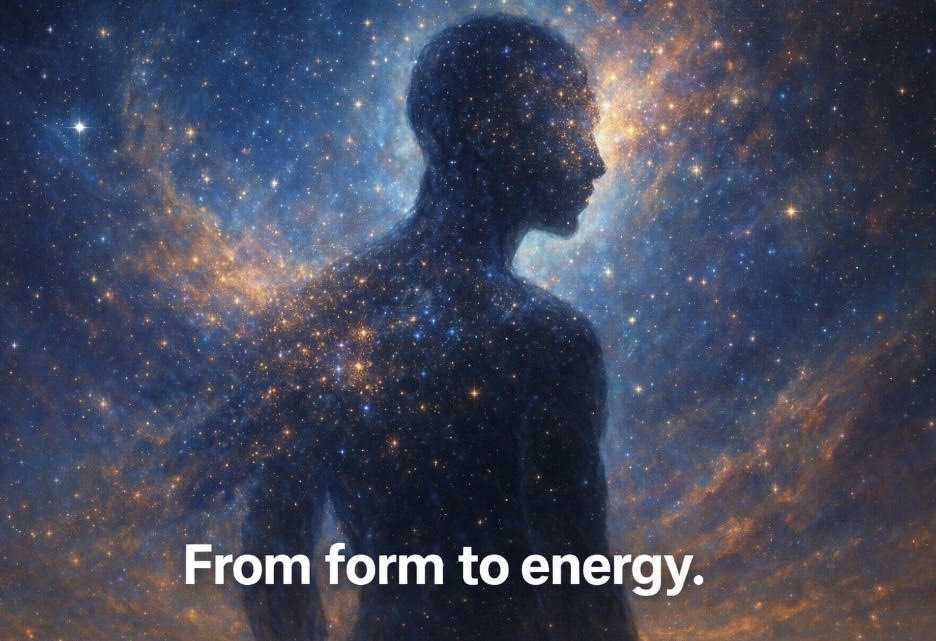
The image accompanying this essay does not aim to suggest transcendence through mystical symbolism, but rather to invite contemplation of the human condition in the face of the vastness of the cosmos. In its restraint, it synthesizes ephemerality, consciousness, and cosmic scale without resorting to religious imagery — precisely as the text proposes in framing human experience as a brief flash of lucidity within the silent immensity of the material universe. A. Montaigne. Montreal, CA