
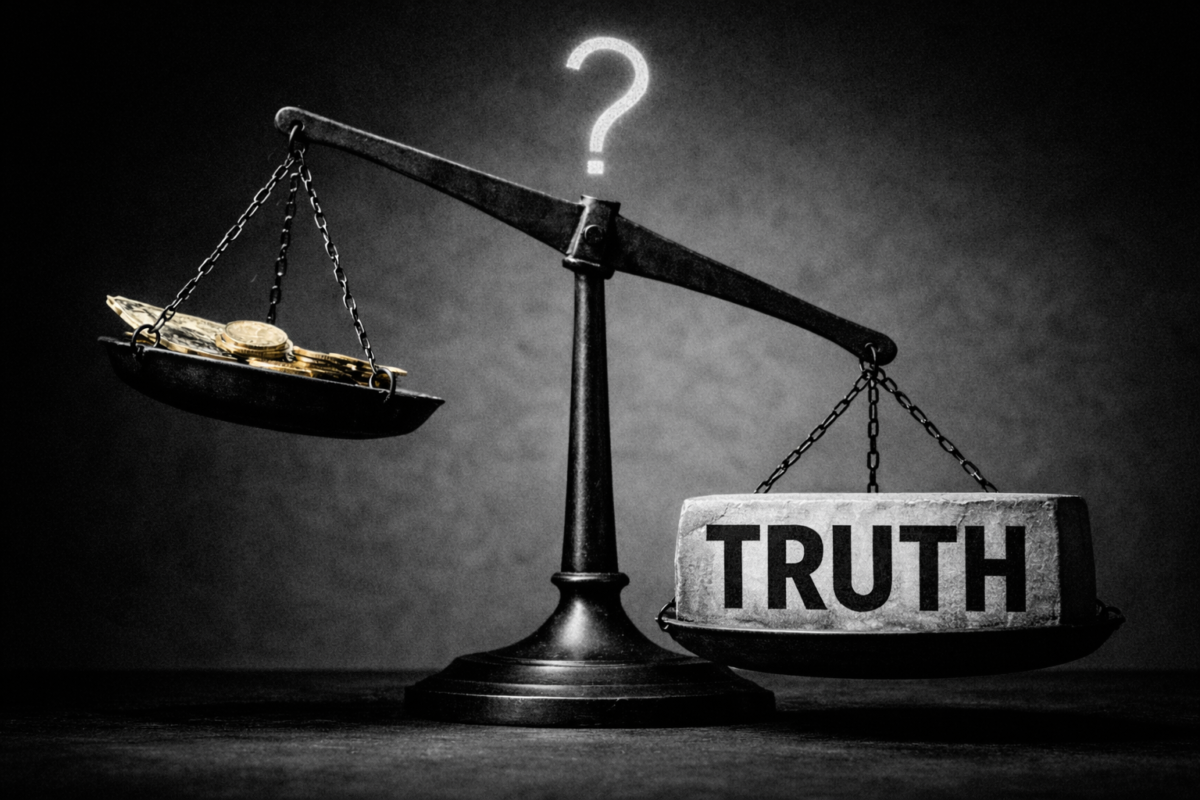
The moral hazard of a monetized judiciary and the ethical dilemma of legal advocacy that normalizes lies. Money cannot outweigh truth in the work of a practitioner of the law—nor in the conscience of a fair judge, who has a duty to separate truth from the monetarist interests of those who seek to buy a verdict.
.
When justice bows to money, it is not merely an individual who loses. The moral contract of democracy itself is fractured. The judiciary ceases to function as an arbiter of reality and becomes an arena of asymmetries, where equality turns into rhetoric and citizenship becomes dependent on budget.
1) A monetized justice system and the invisible harm to democracy
A real democracy is not merely the right to vote. It depends on institutions capable of protecting citizens from abuse—including abuse disguised as legality.
When access to the courts is unequal, truth does not vanish because it does not exist; it vanishes because it cannot be defended.
In a monetized system, litigation becomes a mechanism of attrition: those with resources prolong proceedings, increase pressure, multiply costs, exploit bureaucratic delays, and weaponize procedure. The vulnerable party, exhausted, is often pushed toward surrender. Thus, the law turns into an industry, and the courtroom becomes a stage where financial stamina substitutes for justice.
In such a climate, justice does not fail “occasionally.” It begins to operate as a predictable structure that benefits those who can afford the struggle. And what emerges from that distortion is more dangerous than an isolated error: a culture of institutional permissiveness, where inequality is no longer the exception—it becomes the rule.
2) The ethical dilemma: the lawyer who knows the client is wrong and still fuels the lie
Here, it is essential to distinguish three things:
(A) Defending someone who committed the act is not the same as lying
A lawyer can—and must—protect procedural rights even when the evidence suggests wrongdoing. That includes demanding proper proof, preventing abuse, challenging unlawful practices, and safeguarding due process.
This is not cynicism. It is civilization.
(B) Arguing legal theories is not the same as manufacturing facts
It is legitimate to debate intent, proportionality, reasonable doubt, procedural defects, credibility, admissibility of evidence, jurisdiction, and the interpretation of law.
But it is something else entirely to invent a false factual account, coach a witness to lie, manipulate evidence, deliberately conceal material facts, or build a narrative one knows to be deceptive.
That is no longer zealous advocacy—it is fraud wearing a technical mask.
(C) The ethical boundary: “I know it is false, but I will argue it anyway”
This is the decisive philosophical point: a lawyer is not the “owner” of truth, but cannot become a conscious accomplice of falsehood either.
The ethical core of legal practice should not be “winning at any cost,” but preserving the minimum integrity of the democratic game: a space where facts matter, evidence carries weight, and public reason still has authority.
When a professional, through privileged access and technical understanding, recognizes falsity and still advances it as a method, the lawyer becomes an operator of distortion—turning law into a mechanism of impunity or coercion rather than an instrument of justice.
There is a harsh but necessary formulation:
when deception becomes professional strategy, law ceases to be order and becomes theater.
At this point, one additional clarification becomes necessary. Legal professionals who act with discernment and institutional responsibility understand that no short-term advantage justifies the objective risks of ethical transgression. Disciplinary scrutiny, reputational erosion, sanctions, and—in more serious circumstances—restrictions on professional practice are not hypothetical costs; they are predictable consequences of conduct that crosses clear boundaries. And when those boundaries are deliberately disregarded, the harm extends far beyond the immediate parties: the ultimate victim is society itself, whose trust in the legal system is gradually depleted.
3) Classical foundations: why this corrodes the meaning of justice
This critique is not emotional. It stands on solid philosophical ground.
For Aristotle, justice is a social virtue: a stable disposition to give each person what is due. If money can buy outcomes, the system is no longer distributing justice—it is distributing advantage.
The idea of equity exists to correct the inhuman rigidity of strict formalism. Yet without commitment to truth, equity degenerates into selective flexibility—elastic for the strong, rigid for the weak.
In Kant, lying is not a tactical detail. It is an assault on the structure of public reason itself. Once deception is normalized as a tool, the very foundations of rational judgment collapse.
In Rawls, justice is fairness: a level playing field. When the system structurally favors those with greater resources, the state loses impartiality and becomes an institutional producer of inequality.
In Habermas, legitimacy depends on rational acceptability: reasons, evidence, justification. If outcomes flow from economic advantage rather than reason, decisions are no longer experienced as justice—they are tolerated as imposition.
4) The human consequence: when truth becomes a luxury
The concrete result is not theoretical—it is human. Honest, peaceful citizens begin to feel that justice is a privilege rather than a right.
Once this takes root, the state loses moral authority. And what replaces it is not order, but distrust, resentment, and collective disillusionment.
If opportunism is rewarded and integrity is punished, society is not taught citizenship—it is taught cynicism. And cynicism is the threshold of decline.
Conclusion
When justice bows to money, it is not only truth that weakens—democracy itself decays. The system stops being an arbiter and becomes a marketplace of narratives, where victory goes to the side most capable of funding the most efficient story.
In that environment, the law no longer guarantees equality—it merely manages inequality.
A justice system that can be bought is simply a refined name for organized injustice.