

Progress begins where thought is allowed.
The debate over the role of religion in the public sphere has regained momentum. This is not a confrontation between believers and nonbelievers, but a deeper question: to what extent can—or should—faith be instrumentalized as a political tool without compromising democracy itself?
Human history offers a clear answer. Progress did not emerge from waiting for divine intervention, but from humanity’s capacity to question, investigate, and correct its own errors. Science, method, and critical thinking have been the engines that expanded life expectancy, reduced suffering, created technologies, structured legal systems, and enabled tangible social advances.
The same scholars responsible for these advances have also demonstrated, through rigorous research, what constitutes fact and what amounts to my thmaking in significant portions of historical narratives later labeled as sacred. Even so, for political, economic, or emotional convenience, increasingly unsustainable interpretations continue to be preserved—not by evidence, but by a refusal to submit faith to even the most basic exercise of discernment.
This phenomenon does not represent faith itself. Religious freedom is an essential civilizational achievement and must be fully protected. The problem arises when religion ceases to be an intimate choice and begins to operate as an instrument of power. When that happens, reason is displaced by dogma, and public debate gives way to obedience.
History also shows that the fusion of religion and politics has been among the principal sources of human delay, conflict, and tragedy. In the name of God and love, wars have been waged, dissent persecuted, and millions of lives sacrificed—not because of authentic spirituality, but due to the strategic use of faith to mobilize fear, silence criticism, and consolidate authority.
There is also a contradiction that is hard to ignore. Many who reject scientific thinking benefit daily from its achievements: vaccines, medical treatments, transportation systems, communication, comfort, and security. To attribute these accomplishments exclusively to the divine while dismissing the human effort that made them possible is not faith—it is a denial of collective responsibility.
When societies come to exist between harsh reality and promises of improbable utopias, sold as spiritual certainties, the result is stagnation. Humanity’s delay does not stem from spirituality, but from religious opportunism and resentment—from the instrumentalization of belief for political control.
A mature democracy does not require its citizens to choose between faith and reason. It protects both by keeping their spheres separate. Faith belongs to individual conscience. The state belongs to everyone. When this distinction is lost, so too are freedom, pluralism, and the moral meaning of religion itself.
This argument is not an attack on religion. On the contrary, it:
Explicitly defends freedom of worship
Criticizes obscurantism, not believers
Is grounded in history, science, and ethics
Engages with real concerns in contemporary public debate
Faith is a right. Reason is a responsibility. Confusing these domains has always exacted a high cost from humanity—and it continues to do so.
“Religious freedom is a pillar of democracy, but humanity’s delay begins when faith is captured by opportunism and fanaticism.”
“Faith is an intimate choice; progress is a human endeavor.”
“Confusing these realms has always been costly to civilization.”
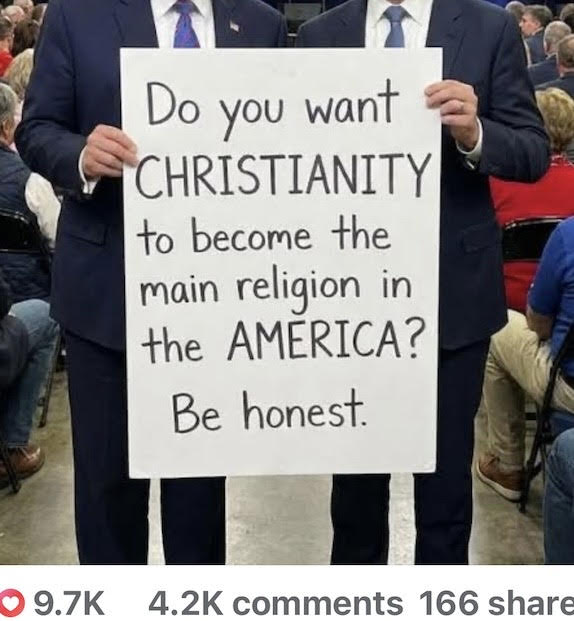
Honestly, No.
– NO. I want freedom of religion, not an official religion. Faith belongs to conscience, not to the state. When power chooses a faith, freedom is already lost.
– NO. A free country doesn’t choose a religion. It protects all of them.
– NO. The Constitution guarantees religious freedom, not religious dominance.